







Many projects focus only on price when procuring compound steel grating, ignoring specification matching and anti-corrosion requirements, leading to later rework. This article lists, in order, the installation method of compound steel grating, typical application scenarios and the conditions to confirm during selection, explaining how to choose under common service conditions; content related to hot-dip galvanized steel grating can directly serve as a reference for technical disclosure.
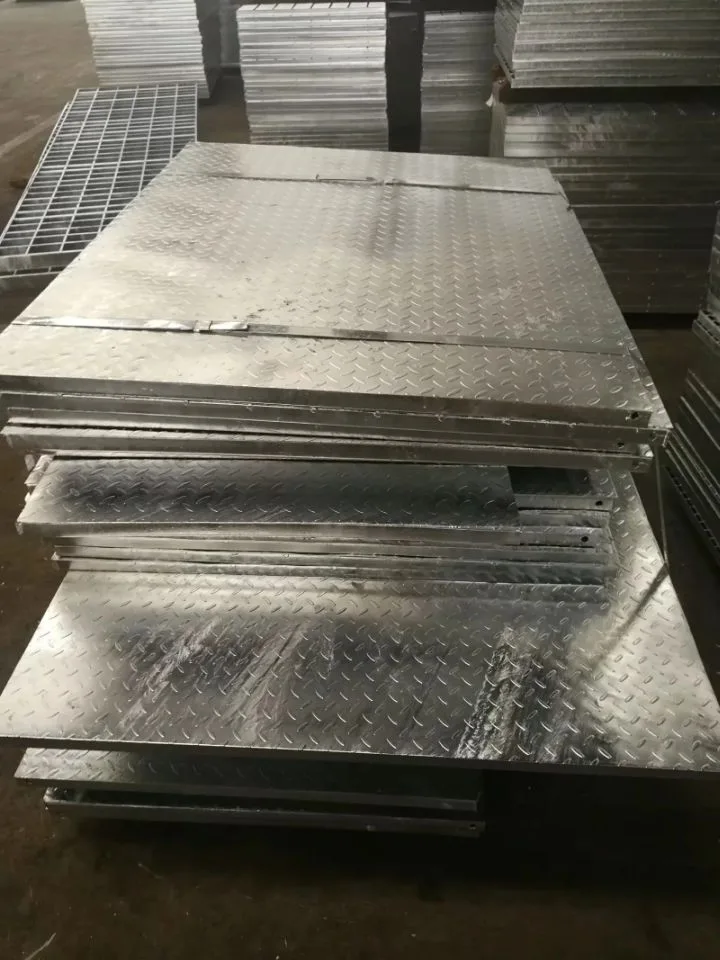
Compound steel grating is a product combining steel grating with a certain spanning capacity and a checkered plate with a sealed surface; the surface is hot-dip galvanized to prevent oxidation. It offers ventilation, lighting, heat dissipation, anti-slip and explosion-proof performance. However, there is no unified standard for installing compound steel grating, so installation methods vary, and some fail to meet the required installation process. There is therefore a need for a quick, accurate and highly practical method that can effectively improve the installation quality of compound steel grating.
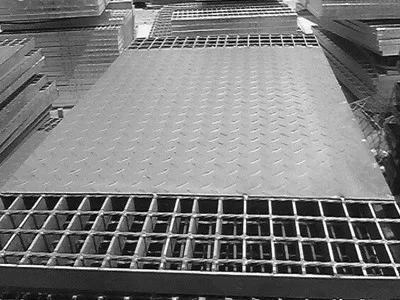
Installation method of compound steel grating
Key points for construction and fixing are as follows:
Step 1: divide the area where the compound steel grating is to be installed into several blocks, number each block, and draw the layout plan of the compound steel grating; first carry out an overall site survey of the installation area, measuring the length, width or radius, curvature and other parameters, then draw a scaled outline of the area based on these parameters, marking the locations where holes need to be reserved or tread plates added. Divide the outline into blocks according to the characteristics of the installation area; since the overall area is often too large to be covered by one set of compound steel grating, it can be divided into two or more blocks, and the joints between blocks are the welding positions, i.e. the welds. When drawing, welds are generally not drawn as straight lines because of their lower strength; instead they are drawn staggered to increase stress strength. Mark the locations requiring reserved holes or overflow weirs; when dividing blocks, a hole or weir is jointly formed by two adjacent blocks. Also note that for edge blocks, i.e. blocks fixed to supporting beams, the contact length with the supporting beam should be no less than one third of the maximum block length to ensure welding strength with the beam.
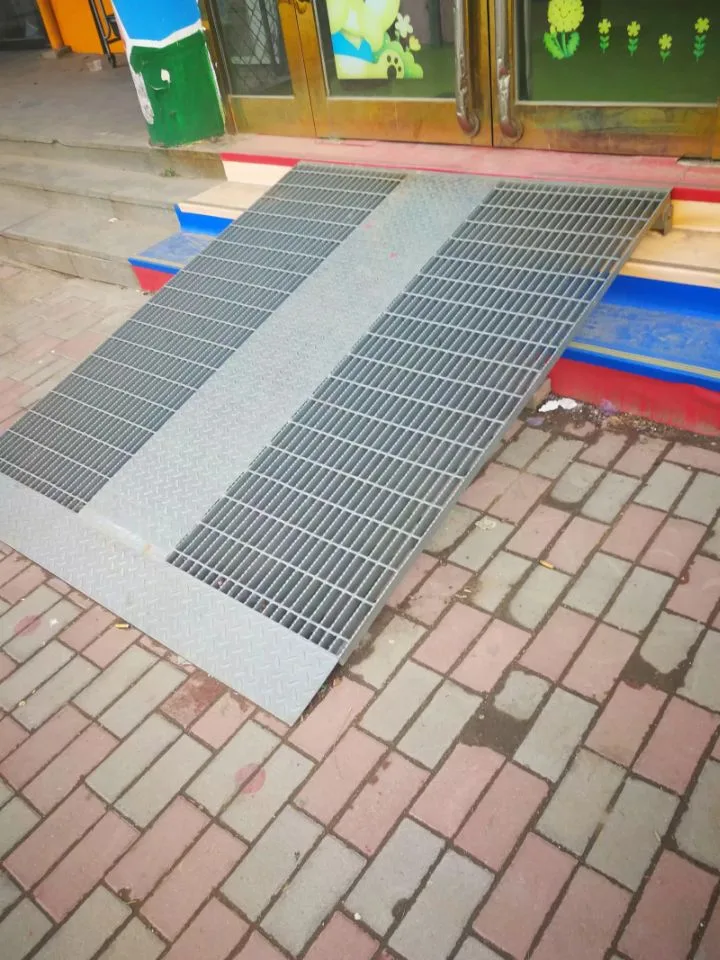
Step 2: fabricate individual compound steel grating panels of the same shape as each block, and mark each panel with the same number as the block of identical shape; numbering ensures that no mistakes occur during assembly, and panels are assembled according to the numbers.
Step 3: in the area where the steel grating is to be installed, assemble the individual panels and fix the edge panels to the supporting beams. During assembly, find the individual panel with the corresponding number for each block per the layout plan, then install the panels at the positions shown in the layout plan. Assemble the individual panels in order from the perimeter to the center.
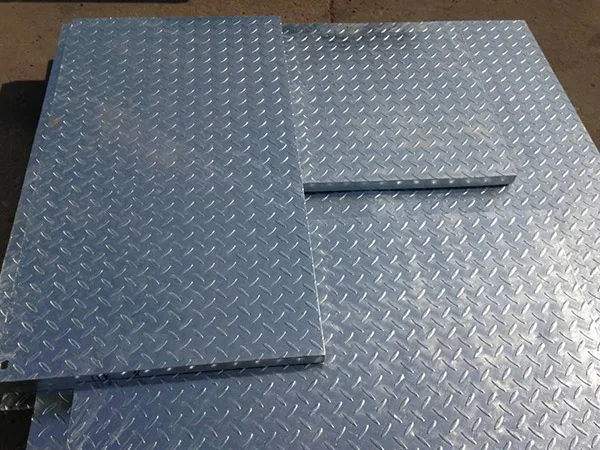
When assembling the individual panels, fix each panel before fixing the next. The overlap length between an individual panel and the supporting beam should be ≥ 25mm, and the gap between two adjacent panels should be less than 15mm. If the compound steel grating will not be dismantled after installation, weld the panels to the supporting beams, remove the welding slag after welding, and spray anti-rust paint of the same color as the compound steel grating on the welds; if a detachable structure is required after installation, fix the panels to the supporting beams with fixing clips, at least four clips per panel. The installation area is a non-rectangular or non-square irregular shape. The installation area contains reserved holes whose diameter exceeds the grid side length of the steel grating; each reserved hole is jointly formed by two adjacent individual panels.
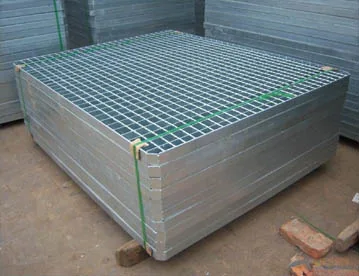
In summary, the installation of compound steel grating uses a block-assembly process, suitable for areas of irregular non-rectangular or non-square shapes and areas with reserved holes. First divide the installation area into several numbered blocks, draw an overall layout plan, fabricate the panels according to the shape of each block so that each panel matches the corresponding block shape and carries the same number, then assemble the panels per the layout plan to complete the installation over the whole area. This installation technique is accurate and fast; the layout plan can be drawn according to the characteristics of the installation area, with blocks divided large or small as needed, the connection contours between adjacent blocks drawn larger where greater connection strength is required, and the positions of reserved holes marked. Then fabricate each panel according to the block shapes and assemble. Compared with previous blind overall or piecewise installation, this method is more purposeful and more accurate in operation, reduces unnecessary waste, and the perimeter-to-center assembly forms a circular work zone, increasing work positions so that more workers can operate simultaneously and speeding up the work.
After installation, check each panel's fixing points and flatness; put into use only after confirming no warping or looseness.
What is most easily overlooked in specification tables are tolerances and end treatment. Compound steel grating usually has machining allowance in the length direction; if recessed installation is used on site, state the banding and corner-cutting requirements in advance. Galvanized grating is handled similarly in these details; mark them clearly on the drawings.
Typical Applications
Main applications are as follows:
- Industrial Platforms & Maintenance Walkways: equipment platforms and inspection passages in power plants, chemical plants and steel-structure workshops;
- Municipal & Landscape: road drainage trench covers, rainwater grates, tree grates, park boardwalks;
- Transportation & Ports: wharf trestles, multi-story parking garage lanes, railway bridge walkways;
- Environmental & Water Treatment: walkways in wastewater treatment plants, tank platforms, screening machine platforms;
- Others: elevated tower platforms, stair treads, fences and railings, etc.
If your working conditions fall outside the above range, you can provide site photos and dimensions, and our technicians will help assess them.
Different parts of the same site often have different requirements. Taking compound steel grating as an example, main passages and corner areas, frequently used areas and occasional maintenance areas can have different specifications; combine galvanized grating by zone, balancing safety and cost.
Key Conditions to Confirm During Selection
We recommend confirming the following factors in order according to service conditions during selection:
- First clarify the span and support beam spacing to determine the required series;
- Then check load requirements by usage type (pedestrian, maintenance, vehicular);
- Finally, determine the surface treatment by service environment (dry indoor, outdoor, coastal, chemical).
Placing the order after confirming these items effectively avoids specification mismatch and on-site rework.
Bigger specifications are not always better. The selection of compound steel grating should be as economical as possible while meeting load requirements; over-thickening increases self-weight and cost and complicates installation. The product page has a fuller comparison of galvanized grating; refer to it before deciding.
Further notes: Common combinations of hot-dip galvanized steel grating and galvanized grating
In engineering, galvanized grating is often used together with the components mentioned in this article. The two differ in load carrying and installation practices; when combining them, pay special attention to the connection of support conditions and fixing methods, as junction treatment is often where problems arise. For unified drawings, submit dimensions of both types and our technicians will process them under the same layout logic.
- For all product specifications and theoretical weights by series, visit Steel Grating Product Center
- To estimate cost by size and quantity, use Instant Quote PageSubmit Requirements
- To see how similar projects were executed, refer to Project Cases field applications
FAQ
What maintenance is required during daily use?
Maintenance mainly involves periodically checking whether fasteners are loose, whether touch-up paint has peeled off, and whether the panel surface shows obvious deformation or rust. Issues found should be dealt with promptly; overall maintenance is minimal.
Can the values in the article be applied directly?
Values in this article come from relevant standard clauses or common industry practice. For actual selection, recalculate based on site span, load class and service environment; direct copying is not recommended.
How to choose between hot-dip galvanizing and cold galvanizing?
The two anti-corrosion mechanisms differ: hot-dip galvanizing immerses steel in molten zinc to form a metallurgically bonded coating, thick and long-lasting, suitable for outdoor and humid environments; cold galvanizing is electrochemical deposition with a thinner, more uniform appearance, suitable for dry indoor environments or applications requiring high dimensional precision.
The above is for sizing and construction reference. To verify specific parameters or request a quotation, please visitInstant Quote Page, or contact our technical staff.
Note that this article presents sizing approaches and general practice, and does not constitute a strength commitment for any specific project. For load-bearing safety-critical areas, the design drawings and on-site calculations shall prevail; contact our technical staff if in doubt.