







The application of heavy-duty steel grating on the market is not complicated in actual projects; the difficulty lies in matching specifications, material and service environment. This article explains in turn heavy-duty steel grating, its features and its composition, so that after reading you have a complete decision framework for drainage trench covers.
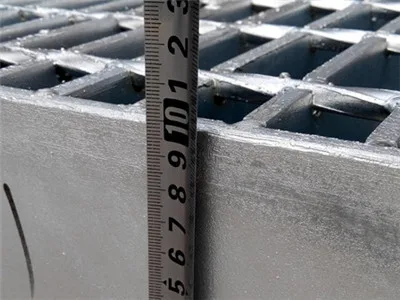
Heavy-Duty Steel Grating
The following aspects most need to be confirmed in advance in actual procurement and use:
It is widely used for industrial floors and walkways, with the advantages of economy, durability and good appearance. Gratings of different specifications can meet the requirements of thousands of applications. However, limited by the bearing bar specifications, their loads are restricted to a certain range; existing steel grating cannot bear the rolling of heavy-load vehicles, has low load capacity and a structure that is not strong. To overcome the shortcomings of the existing technology, this article presents a high-load heavy-duty steel grating. Its advantage is suitability for roads, bridges, ports, docks, airports, mines, power plants, freight yards and similar environments with heavy vehicle traffic and drainage (rain, snow) requirements; used in elevated bridge construction, concrete can be cast directly on it. It solves the problems of heavy drainage and snow removal on municipal roads, frequent rolling by heavy vehicles, airport drainage systems, and the drainage and steel structure needs of elevated bridges.
The above points can serve as a pre-purchase checklist; confirm each item before moving to the quotation stage.
Bigger is not always better for specifications. The selection of heavy-duty steel grating on the market should be as economical as possible while meeting the load requirements; over-thickening increases self-weight and cost and also makes installation inconvenient. The product page gives a more complete comparison for drainage trench covers, which can be consulted before deciding.
Features of Heavy-Duty Steel Grating
Main features can be summarized as follows:
The greatest feature of heavy-duty steel grating is its very large load capacity and the strongest impact resistance. Serrated steel grating is recommended, which provides better friction. It is the first-choice product for sites with heavy loads and dense vehicle traffic. Press-locked construction is best, as it effectively prevents the bearing bars from tilting and losing stability and avoids deformation of the bearing bars.
Overall, selection should weigh span, load and service environment together.
From ordering to delivery, the intermediate steps of heavy-duty steel grating on the market are mainly layout confirmation and surface treatment, and these two steps take a relatively fixed time. If the schedule is tight, the layout drawing can be finalized first, so that the production schedule of hot-dip galvanized trench covers can also advance in parallel.
Composition of Heavy-Duty Steel Grating
Additional key points are as follows:
The high-load heavy-duty steel grating is composed of H-beams and flat bars. The H-beams are arranged at a set pitch; web holes are distributed on the webs of the H-beams with a web hole pitch; slot holes are distributed on the load-bearing flat bars with a slot hole pitch; the web hole pitch and slot hole pitch match the arrangement pitch, and the load-bearing flat bars are inserted into the web holes and welded to the beams. The cross bars are wedged into the slot holes of the load-bearing flat bars and welded into the slots. The H-beams, load-bearing flat bars and cross bars form an integral load-bearing frame by welding, crossing into a square-mesh panel. The ends of the mesh panel are connected by two end plates, and the two parallel sides of the H-beams are bound by two edge flat bars. The beams are anti-slip H-beams; the load-bearing flat bars are plain or serrated flat bars; the cross bars are flat bars, serrated flat bars or twisted square bars.
The heavy-duty steel grating of power plants connects 150*14 flat bars with 20mm round bars by piercing, and the surrounding edge is welded with 150*110*12 angle steel. The center pitch of flat bar to flat bar is 50mm, and the center pitch of round bar to round bar is 330mm. After the black semi-finished product is made, spatter, welding slag and burrs must be removed, the four corners ground free of sharp edges, and the whole panel leveled.
Welding requirements: JuLi welding wire is used; the weld between the flat bars and the angle steel is a full, double-sided weld. The weld between the 20mm round bar and the flat bar is not less than 15mm.
The above points can serve as a pre-purchase checklist; confirm each item before moving to the quotation stage.
There is a practical trick for confirming specifications: write the bearing bar size, bearing bar center pitch, cross bar pitch and overall dimensions into the purchase list at the same time; specifying only one or two of them easily leads to goods that do not match. The complete specification notation of heavy-duty steel grating on the market is compared on the product page; before ordering, check panel by panel against the layout drawing, and the same applies to drainage trench covers.
Features of Heavy-Load Steel Grating
Its overall performance focuses on the following aspects; we suggest comparing item by item in actual selection:
- By punching holes in the web of the H-beam, the load-bearing flat bars can be inserted; holes punched on the load-bearing flat bars match the H-beam flanges so that the two interlock. By punching holes on the load-bearing flat bars and inserting the cross bars, the three materials interpenetrate, allowing H-beams, load-bearing flat bars and cross bars of different specifications to be cross-combined and welded at different pitches to meet different customer needs.
- Taking only the H-beam H150*75*7*5 as an example, its moment of inertia is 679cm2, while the flat bar of ordinary floor maintenance grating FB505 has a moment of inertia of 5.21cm3; under the same service conditions, the former resists deformation 130 times better than the latter. At a span of 1100mm it withstands the instantaneous impact and rolling of a 25-ton truck.
- Substructure: a number of anchors are welded onto angle steel or Z-section steel as the foundation of the heavy-load grating and cast integrally with the concrete, so no channel lip needs to be made, making the product easier to lay and the foundation more impact-resistant.
- The key point of the high-load heavy-duty steel grating is the design of the interlocking holes between the H-beam and the flat bars; the design is ingenious and perfectly achieves the transfer and coordination of forces.
- The advantage of the high-load heavy-duty steel grating is its suitability for the drainage and snow-removal systems of roads, bridges, ports, docks, airports, mines, power plants, freight yards and similar environments with heavy vehicle traffic and drainage requirements. Used in elevated bridge construction, concrete can be cast directly on it, giving the bridge body greater load capacity and impact resistance and making site construction easier.
- Because of its large open area, the high-load heavy-duty steel grating effectively reduces wind and water pressure, with good drainage and snow removal. It is corrosion- and rust-resistant, with a service life of up to 70 years. It is easy to build and maintain, economical, durable and high-strength, with advantages unmatched by other products.
- The H-beams can be replaced with anti-slip checkered types, the load-bearing flat bars can be extended to anti-slip serrated flat bars, and the cross bars can be extended to serrated flat bars, twisted square bars, construction rebar and other materials, meeting different applications by adjusting the pitches of these three materials.
Overall, selection should weigh span, load and service environment together.
The details most easily overlooked when reading a specification table are tolerances and end treatment. Heavy-duty steel grating on the market usually keeps a machining allowance in the length direction; if the site uses embedded installation, edge sealing and corner-cutting requirements should be stated in advance. Drainage trench covers are handled similarly in such details, so mark them clearly on the drawings as well.
Further Reading: Selection Points for Drainage Trench Covers and Hot-Dip Galvanized Trench Covers
Besides what this article covers, drainage trench covers are also common in actual projects. It shares similarities with this article's subject in structure and fabrication; for selection, check span, load and service environment in the same order. If both types of components are used in the same project, we recommend unifying material and surface treatment to avoid later galvanic corrosion or inconsistent appearance.
- For all product specifications and theoretical weights by series, visit Steel Grating Product Center
- To estimate cost by size and quantity, use Instant Quote PageSubmit Requirements
- To see how similar projects were executed, refer to Project Cases field applications
FAQ
Why do different manufacturers quote different weights for the same specifications?
The main difference lies in the actual measured thickness and tolerance control of the bearing bars. When bars are supplied at the lower tolerance limit, weight per unit area falls below the theoretical value, and load capacity drops accordingly. We recommend specifying thickness tolerance clearly when purchasing.
What is most often overlooked during installation and acceptance?
First, bearing bars installed in the wrong direction reduce load capacity; second, insufficient fixing points or missing zinc touch-up paint; third, support beam spacing inconsistent with the layout drawing. These three items are most often overlooked on site.
How to choose between hot-dip galvanizing and cold galvanizing?
The two anti-corrosion mechanisms differ: hot-dip galvanizing immerses steel in molten zinc to form a metallurgically bonded coating, thick and long-lasting, suitable for outdoor and humid environments; cold galvanizing is electrochemical deposition with a thinner, more uniform appearance, suitable for dry indoor environments or applications requiring high dimensional precision.
The above is for sizing and construction reference. To verify specific parameters or request a quotation, please visitInstant Quote Page, or contact our technical staff.
If you already have drawings or site dimensions, submit them directly and we will help verify specifications and layout, avoiding on-site cutting and rework caused by mismatched models. Without drawings, site photos and approximate dimensions are enough for an estimate.