







Many projects focus only on price when purchasing steel cover plates, overlooking specification matching and anti-corrosion requirements, which often leads to rework. This article lists the conditions to confirm in the order of cover plate features, high strength and light structure, and basic concepts, and explains trade-offs under common conditions; the sections on hot-dip galvanized steel grating can be used as a reference for technical disclosure.
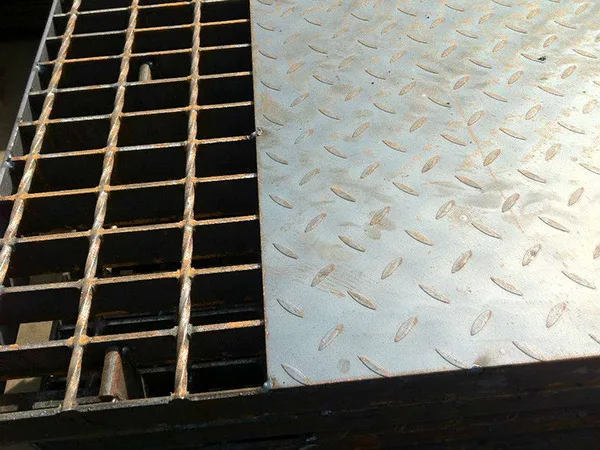
Steel Cover PlateA steel cover plate is a new steel grating product composed of steel grating with a certain spanning capacity and a checkered steel plate or steel mesh with sealed surface. It can be made of any model of steel grating with checkered plate of different thicknesses; the most common specification is G323/40/100 as the base grating, with the checkered plate commonly 3mm thick, and 4mm, 5mm or 6mm plate also available.
Features of Steel Cover Plates
Main features can be summarized as follows:
Overall, selection should weigh span, load and service environment together.
The recommended selection sequence is fixed: first determine span and support conditions, then load requirements, and finally surface treatment. Following this order, the cover plate specification can basically be determined; picking a model first and then fitting conditions tends to cause repeated revisions. The same applies to hot-dip galvanized steel grating.
Steel cover plates feature high strength, light structure, strong corrosion resistance and durability
Its overall performance focuses on the following aspects; we suggest comparing item by item in actual selection:
2. With an attractive appearance, bright surface and no dirt accumulation, steel grating sheds rain and snow without pooling water, is self-cleaning and easy to maintain, and has therefore been widely applied in recent years.
3. Good ventilation, daylighting, heat dissipation, slip resistance and explosion-proof performance, and very convenient to install and disassemble.
Overall, selection should weigh span, load and service environment together.
For material selection, pursuing high grades alone is not recommended. The material of steel cover plates should match load requirements and service environment; over-specifying causes unnecessary cost increases. For the treatment of hot-dip galvanized steel grating panels, refer to the product page and choose according to actual service conditions.
High strength, lightweight structure
This part may seem basic, but it is often the source of later disputes. Stating the structure, material and surface treatment clearly in communication is far more reliable than agreeing on a name alone. The same approach applies to selecting hot-dip galvanized steel grating.
Strong corrosion resistance, durable
Regarding corrosion protection, one thing is easily overlooked: on-site cutting and welding damage the original coating, and these areas need zinc touch-up after construction, otherwise rust often starts from the cut edges. Hot-dip galvanized steel grating has the same issue; it is best to include this in the technical requirements at the construction disclosure.
Attractive appearance with a bright surface
Note that the specific practices of steel cover plates vary with project conditions; this article gives general guidance rather than fixed answers. In practice, confirm the site span, support conditions and traffic requirements first, then implement item by item; for hot-dip galvanized steel grating the same logic applies, and a final review before ordering is still recommended.
No dirt accumulation, no rain or snow buildup, no water pooling; self-cleaning and easy to maintain
8. Good ventilation, daylighting, heat dissipation, slip resistance and explosion-proof performance.
9. Easy to install and disassemble.
The installation quality of steel cover plates largely depends on preparation: whether the bearing surfaces are flat, whether beam spacing matches the layout, and whether fasteners are prepared in advance. With these in place, installation itself is not complicated. If cutting is needed on site, the cut-edge treatment requirements of hot-dip galvanized steel grating should also be clearly stated.
Further reading: Selection points for hot-dip galvanized steel grating and hot-dip galvanized steel grating
Hot-dip galvanized steel grating and hot-dip galvanized steel grating are different specification forms within the same product system. The selection logic is the same as described in this article: first the usage type, then span and load to determine specifications, and finally the environment to determine surface treatment. Their corrosion protection and anti-slip requirements may differ; state them separately when ordering rather than writing one general technical requirement.
- For all product specifications and theoretical weights by series, visit Steel Grating Product Center
- To estimate cost by size and quantity, use Instant Quote PageSubmit Requirements
- To see how similar projects were executed, refer to Project Cases field applications
FAQ
What is most often overlooked during installation and acceptance?
First, bearing bars installed in the wrong direction reduce load capacity; second, insufficient fixing points or missing zinc touch-up paint; third, support beam spacing inconsistent with the layout drawing. These three items are most often overlooked on site.
What information is needed for custom sizes?
Usually you need to provide the panel dimensions (length x width), bearing bar specs and direction, center-to-center pitch of bearing bars and cross bars, surface treatment, and special requirements such as cutouts, corner notches and banding. Site photos or sketches are even better.
What maintenance is required during daily use?
Maintenance mainly involves periodically checking whether fasteners are loose, whether touch-up paint has peeled off, and whether the panel surface shows obvious deformation or rust. Issues found should be dealt with promptly; overall maintenance is minimal.
The above is for sizing and construction reference. To verify specific parameters or request a quotation, please visitInstant Quote Page, or contact our technical staff.
If you already have drawings or site dimensions, submit them directly and we will help verify specifications and layout, avoiding on-site cutting and rework caused by mismatched models. Without drawings, site photos and approximate dimensions are enough for an estimate.