







Applying steel grating in real projects is not complicated; the difficulty is matching specifications, materials and environment. This article covers technical requirements, materials and product selection, and features of galvanized steel grating in turn, giving a complete judgment framework for hot-dip galvanized steel grating.
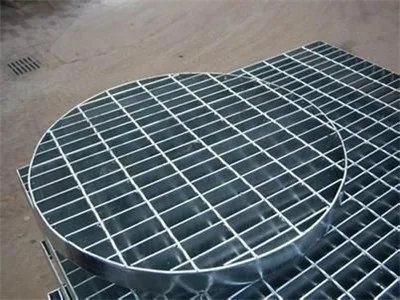 1. Steel grating
Steel grating is a metal product made by cross-arranging bearing flat bars and cross bars at fixed pitch and welding them into square openings; cross bars are usually twisted square bars, or round or flat bars. A hot-dip galvanized surface prevents oxidation. Steel grating suits alloy, building materials, power stations, boilers, shipbuilding, petrochemical and general industrial plants and municipal construction. It offers ventilation, light transmission, slip resistance, strong load capacity, attractive appearance, durability, easy cleaning and simple installation, and is widely used across industries at home and abroad.
Technical requirements
The standards and inspection items to check are as follows:
2.1 All materials must be purchased strictly per required dimensions and must guarantee the manufacturing dimensions of the steel grating.
2.2 Twisted square bars must fit tightly and be welded onto the bearing bars, and the mechanical strength of bearing bars must not be reduced by grooves or holes.
2.3 The minimum support length of bearing bars equals the grating thickness, minimum 30mm.
2.4 Edging uses single-side fillet welds with weld height not less than the bearing bar thickness, and weld length not less than four times the bearing bar thickness.
2.5 Fixing the grating: 3 welds per edge, one at the plane centerline, one at each end; weld positions may be at the inner or outer side of the frame wherever easiest to weld. Weld length equals the mesh width.
2.6 Under general or special use, the grating dimensions must not allow a 28.5mm diameter ball to pass through standard 27×50 or 27×100 openings (Figure 1); the maximum clear spacing of bearing bars and cross bars must not exceed 30mm.
We recommend checking each clause above during acceptance and keeping the factory inspection records.
What is most easily overlooked in spec tables are tolerances and end treatment. Steel grating usually has machining allowance in the length direction; if embedded installation is used on site, edge closing and corner notch requirements must be stated in advance. Hot-dip galvanized steel grating is handled similarly in these details; we recommend marking them clearly on the drawings as well.
Materials and product selection
Common materials and surface treatments are as follows:
The grating material is Q235A; steel is purchased and inspected per Chinese standard procedures. The protective layer is hot-dip galvanizing with zinc coating of 500g/m2. The grating thickness equals the width of the bearing bars under all conditions.
Once material and surface treatment are decided, we recommend writing zinc coating thickness and appearance requirements into the technical agreement.
Choosing a surface treatment is essentially balancing initial investment against later maintenance. Requirements can be relaxed for indoor dry environments and raised for outdoor or humid environments. Galvanized grating selection follows the same logic.
Features of galvanized steel grating
Main features can be summarized as follows:
- , toe plates (edge boards), checkered plate guards, connectors and other accessories can be welded around the perimeter.
- , edging can use flat bars of different specifications from the bearing bars, or angle steel, channel steel or square tubes.
- , handles and hinges can be installed on platform steel grating that is frequently moved or opened.
- , the edging welding standard for platform steel grating is: Series 1 - one weld every five bars; Series 2 - one every four; Series 3 - one every three. Welds are single-side fillet welds of not less than 3mm, 20mm long.
Steel grating is widely used in petroleum, chemical, power, water supply, wastewater treatment, ports and docks, architectural decoration, shipbuilding, self-service parking, municipal engineering and sanitation projects for platforms, walkways, trestles, trench covers, manhole covers, ladders, fences and more.
Overall, selection should weigh span, load and service environment together.
Bigger is not always better. Steel grating selection should be as economical as possible while meeting load requirements; excessive thickness increases weight and cost and complicates installation. The product page provides fuller cross-references for hot-dip galvanized steel grating - review them together before deciding.
Further reading: Sizing reference for hot-dip galvanized steel grating and galvanized grating
Hot-dip galvanized steel grating and galvanized grating are different specification forms within the same product system. The selection logic is the same as described in this article: first the usage type, then span and load to determine specifications, and finally the environment to determine surface treatment. Their corrosion protection and anti-slip requirements may differ; state them separately when ordering rather than writing one general technical requirement.
- For all product specifications and theoretical weights by series, visit Steel Grating Product Center
- To estimate cost by size and quantity, use Instant Quote PageSubmit Requirements
- To see how similar projects were executed, refer to Project Cases field applications
FAQ
Can the values in the article be applied directly?
Values in this article come from relevant standard clauses or common industry practice. For actual selection, recalculate based on site span, load class and service environment; direct copying is not recommended.
What is most often overlooked during installation and acceptance?
First, bearing bars installed in the wrong direction reduce load capacity; second, insufficient fixing points or missing zinc touch-up paint; third, support beam spacing inconsistent with the layout drawing. These three items are most often overlooked on site.
Where can I find specific specifications?
our websiteProductsCommon specifications and theoretical weights are organized by series, also available in Instant Quote PageEstimate by size, or contact us directly for sizing advice.
The above is for sizing and construction reference. To verify specific parameters or request a quotation, please visitInstant Quote Page, or contact our technical staff.
Note that this article presents sizing approaches and general practice, and does not constitute a strength commitment for any specific project. For load-bearing safety-critical areas, the design drawings and on-site calculations shall prevail; contact our technical staff if in doubt.