







This article covers press-locked steel grating in three parts - what press-locked grating processing and installation is, application scope and engineering fields, and steel grating installation methods - with practical advice after each part. If you are comparing solutions or preparing for procurement, check item by item in the order presented; parts involving hot-dip galvanized steel grating can be confirmed against the same list, adjusting for actual site conditions.
What Is Press-Locked Steel Grating Processing and Installation
Below we first briefly explain the relevant concepts and basic construction to make the following parameters and sizing content easier to understand.
Steel GratingThe punch press automatic feeder consists of three main parts: a material reel, a leveling and conveying unit, and the press. The unit has the following features:
| Item | Description |
|---|---|
| CNC Control Console | Built-in touchscreen, imported PLC, feeder motor speed controller, and other components to control the operation of the entire equipment. |
| Punching | Fully computer-controlled, with uniform hole pitch and high precision. |
| Shearing | Achieves fast shearing with reliable, stable performance. |
| Feeding Unit | Uses a leveling feeder that moves the flat bars at constant speed; the rollers have high pressure and a high friction coefficient, thus strong pulling force with no slipping - the key to high-precision feeding. |
| Control Motor | Accurate stopping, fast feeding speed, stable operation. |
| Easy Operation | After setting the flat bar shear length and the number of holes, the machine feeds, punches, and shears automatically, greatly reducing operator workload and labor costs. A great tool for cutting costs and increasing profits." |
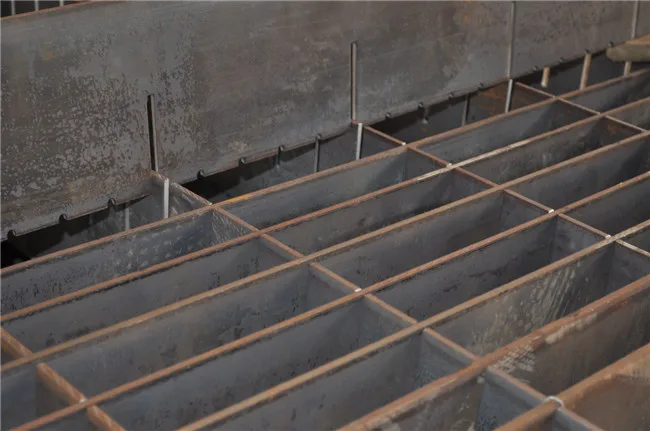
Press-locked steel grating, also called interlocked steel grating, is made from ordinary low-carbon flat bars, stainless steel, brass plates or aluminum plates of specified sizes through slotting (punching), interlocking, welding and finishing. The product has firm weld points, uniform hole spacing and an elegant, practical design. Press-locked steel grating has all the features of ordinary steel grating - high strength, corrosion resistance, maintenance-free - plus unique characteristics of uniform and precise combination, light and refined structure, natural harmony and elegant style. It is both a functional product and a work of art, and has been widely applied.
Once you grasp these basic concepts, the specifications and sizing recommendations that follow will be much easier to understand.
Bigger is not always better. The selection of press-locked steel grating should be as economical as possible while meeting load requirements; excessive thickness increases weight and cost and complicates installation. The product page offers a more complete cross-reference for hot-dip galvanized steel grating; consult it before deciding.
Scope of Application & Engineering Fields
Main applications are as follows:
Often used for fixing steel grating on machinery; the advantage is easy disassembly, no weld marks on the beams, and no impact on the galvanized coating. It is especially suitable for projects with higher requirements.
If your working conditions fall outside the above range, you can provide site photos and dimensions, and our technicians will help assess them.
What is easiest to overlook in spec sheets are tolerances and end treatment. Press-locked steel grating usually leaves machining allowance along the length; if field installation is recessed, state the edge banding and corner-notching requirements in advance. Hot-dip galvanized steel grating is handled similarly in these details; mark them clearly on the drawings.
Steel Grating Installation Methods
On-site construction generally follows the steps and technical requirements below; complete the technical disclosure before starting work:
- Weld the steel grating or stair treads directly onto the supporting steel structure, and apply two coats of zinc-rich silver paint at the welds.
- Use the dedicated triangular steel grating installation clips, which do not damage the galvanized layer and allow easy disassembly. Each clip set includes one upper clip, one lower clip, one M8 round-head bolt, and one nut.
- Stainless steel installation clips or bolted connections and other fastening methods can be provided as needed.
- The installation gap for steel grating is generally 10MM.
- Be sure to install firmly and reliably, and check regularly to prevent the clips from loosening or falling off. Steel grating near vibration sources is best welded or fitted with rubber pads."
After installation, check each panel's fixing points and flatness; put into use only after confirming no warping or looseness.
Choosing a surface treatment is essentially balancing initial investment against later maintenance. Requirements can be relaxed somewhat for press-locked steel grating in dry indoor environments, but should be raised for outdoor or humid environments. The same reasoning applies to selecting hot-dip galvanized steel grating.
Further notes: Common combinations of hot-dip galvanized steel grating and hot-dip galvanized steel grating
In engineering, hot-dip galvanized steel grating is often used together with the components mentioned in this article. The two differ in load carrying and installation practices; when combining them, pay special attention to the connection of support conditions and fixing methods, as junction treatment is often where problems arise. For unified drawings, submit dimensions of both types and our technicians will process them under the same layout logic.
- For all product specifications and theoretical weights by series, visit Steel Grating Product Center
- To estimate cost by size and quantity, use Instant Quote PageSubmit Requirements
- To see how similar projects were executed, refer to Project Cases field applications
FAQ
What is most often overlooked during installation and acceptance?
First, bearing bars installed in the wrong direction reduce load capacity; second, insufficient fixing points or missing zinc touch-up paint; third, support beam spacing inconsistent with the layout drawing. These three items are most often overlooked on site.
Why do different manufacturers quote different weights for the same specifications?
The main difference lies in the actual measured thickness and tolerance control of the bearing bars. When bars are supplied at the lower tolerance limit, weight per unit area falls below the theoretical value, and load capacity drops accordingly. We recommend specifying thickness tolerance clearly when purchasing.
What information is needed for custom sizes?
Usually you need to provide the panel dimensions (length x width), bearing bar specs and direction, center-to-center pitch of bearing bars and cross bars, surface treatment, and special requirements such as cutouts, corner notches and banding. Site photos or sketches are even better.
The above is for sizing and construction reference. To verify specific parameters or request a quotation, please visitInstant Quote Page, or contact our technical staff.
If you already have drawings or site dimensions, submit them directly and we will help verify specifications and layout, avoiding on-site cutting and rework caused by mismatched models. Without drawings, site photos and approximate dimensions are enough for an estimate.