







The application of special-shaped steel grating in actual projects is not complicated; the difficulty lies in matching specifications, materials and service environment. This article covers: precautions for cutouts in special-shaped steel grating,"serrated steel grating features,"and steel grating selection, in sequence. After reading, you will have a complete framework for judging drainage trench covers.
Specification parameters for cutouts in special-shaped steel grating
Common specifications and corresponding parameters are summarized below; confirm each item before ordering:
Although on-site cutouts in steel grating can best accommodate various equipment on steel structure platforms, this treatment has many shortcomings. First, the cut cross-section of the bearing bars is exposed, posing a safety hazard. Second, on-site cutouts interrupt the bearing bars, so loads cannot be transferred and distributed, causing obvious load concentration at the cutout and greatly reduced mechanical performance.
G255/30/100: low-carbon steel; the specification means the bearing bar width is 25mm and the thickness is 5mm; bearing bar pitch 30mm, cross bar pitch 100mm. G255A/1: bearing bar width 25mm, thickness 5mm; A indicates a cross bar pitch of 100mm; 1 indicates a bearing bar pitch of 30mm
The above are common specifications; actual ordered dimensions and tolerance requirements shall be confirmed against the layout drawing.
A practical tip for confirming specifications: write the bearing bar size, bearing bar center pitch, cross bar pitch and overall dimensions into the purchase list together; specifying only one or two items easily leads to goods mismatch. The specification marking of special-shaped steel grating is fully cross-referenced on the product page; before ordering, check each panel against the layout drawing by number - the same applies to hot-dip galvanized trench covers.
"Features of Serrated Steel Grating
Main features can be summarized as follows:
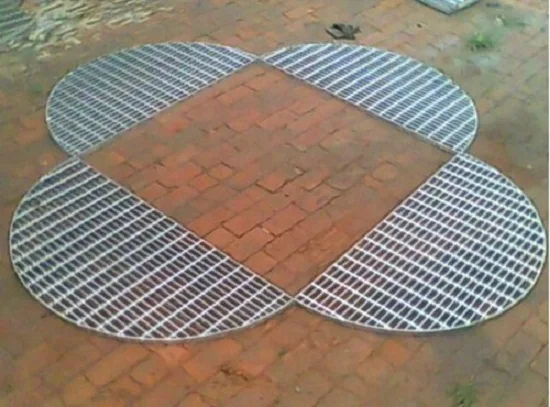
Serrated steel grating uses high-strength carbon steel, giving the grating very high strength: strength and toughness far exceed cast iron, suitable for docks, airports and other large-span, heavy-load environments. The product features large mesh openings with the best drainage: open area reaches 83.3%, more than twice that of cast iron. Attractive appearance: clean lines, silver finish, modern look; economical material use, saving investment: lower in price than cast iron for large spans and heavy loads; and it saves the cost of replacing cast iron covers stolen or crushed. "
Overall, selection should weigh span, load and service environment together.
To judge whether a site can use special-shaped steel grating, quickly check three aspects: whether there are corrosive media, whether traffic is pedestrian or vehicular, and the approximate span range. With these three points clear, the required specifications and surface treatment of the drainage trench cover can basically be determined.
"Selection of flat bar types for steel grating
Main types are classified as follows:
Determine the category first and then the specific model; this saves detours and makes comparison with other materials easier.
Actual parameters of the same model may differ slightly between manufacturers; acceptance should be based on measured values. Spot-check the key dimensions of special-shaped steel grating, especially for bulk deliveries. The corresponding parameters of drainage trench covers can be checked the same way; communicate promptly if deviations are found.
According to flat bar type, steel grating is mainly divided into the following three categories, with their respective features as follows:
Plain type: plain steel grating is the most widely used, mainly for platforms, walkways, various trench covers, stair treads, etc.
Serrated type: compared with plain steel grating, serrated steel grating has better anti-slip performance.
I-type: compared with plain steel grating, I-type steel grating is lighter and more economical without greatly reducing load capacity."
The application range of special-shaped steel grating is actually wider than many people think, from industrial platforms to municipal landscaping. The difference: industrial scenarios focus more on load capacity and corrosion protection, while municipal scenarios also consider appearance, anti-theft and pedestrian safety. Common practices for hot-dip galvanized trench covers in these scenarios can be viewed on the case page.
Further notes: Common combinations of drainage trench covers and hot-dip galvanized trench covers
Besides what this article covers, drainage trench covers are also common in actual projects. It shares similarities with this article's subject in structure and fabrication; for selection, check span, load and service environment in the same order. If both types of components are used in the same project, we recommend unifying material and surface treatment to avoid later galvanic corrosion or inconsistent appearance.
- For all product specifications and theoretical weights by series, visit Steel Grating Product Center
- To estimate cost by size and quantity, use Instant Quote PageSubmit Requirements
- To see how similar projects were executed, refer to Project Cases field applications
FAQ
What is most often overlooked during installation and acceptance?
First, bearing bars installed in the wrong direction reduce load capacity; second, insufficient fixing points or missing zinc touch-up paint; third, support beam spacing inconsistent with the layout drawing. These three items are most often overlooked on site.
Can the values in the article be applied directly?
Values in this article come from relevant standard clauses or common industry practice. For actual selection, recalculate based on site span, load class and service environment; direct copying is not recommended.
Why do different manufacturers quote different weights for the same specifications?
The main difference lies in the actual measured thickness and tolerance control of the bearing bars. When bars are supplied at the lower tolerance limit, weight per unit area falls below the theoretical value, and load capacity drops accordingly. We recommend specifying thickness tolerance clearly when purchasing.
The above is for sizing and construction reference. To verify specific parameters or request a quotation, please visitInstant Quote Page, or contact our technical staff.
If you already have drawings or site dimensions, submit them directly and we will help verify specifications and layout, avoiding on-site cutting and rework caused by mismatched models. Without drawings, site photos and approximate dimensions are enough for an estimate.