







Many projects focus only on price when purchasing platform steel grating, ignoring specification matching and anti-corrosion requirements, which often leads to rework. This article lists, in the order of"platform steel grating materials, I-type flat bar cross-section dimensions and cross-section, and basic concepts, the conditions to confirm one by one, and explains how to make trade-offs under common working conditions; the content related to galvanized steel grating can be used directly as technical disclosure reference.
Platform Steel Grating" which is a steel grating product widely used in recent years, the most widely used in various industrial fields, with the strongest resistance to surface impact; especially the grating with a 50mm cross bar pitch has strong resistance to lateral impact.
"Platform steel grating materials
Common materials and surface treatments are as follows:
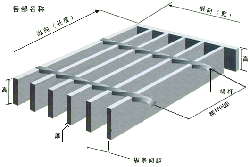
- Bearing bars and cross bars are made of Q235 per GB/T 700; other materials can be used per user requirements.
- Bearing bars use hot-rolled flat bars or longitudinally slit hot-rolled or cold-rolled steel strips.
- Dimensional tolerances of bearing bars comply with Table 1 of YB/T 4001.1-2007.
- Serrated bearing bars use hot-rolled flat bars or longitudinally slit and toothed hot-rolled or cold-rolled steel strips. There must be no fewer than 5 teeth per 100mm.
Once material and surface treatment are decided, we recommend writing zinc coating thickness and appearance requirements into the technical agreement.
The most easily overlooked items in specification tables are tolerances and end treatment. Platform steel grating usually retains machining allowance along the length; if embedded installation is used on site, edge sealing and corner-cutting requirements should be stated in advance. Hot-dip galvanized steel grating is handled similarly in such details; it is recommended to mark them clearly on the drawings.
I-type flat bar cross-section dimensions and cross-section"
Common specifications and corresponding parameters are summarized below; confirm each item before ordering:
The production process of special-shaped steel grating is more complex, requiring corner cutting, arc cutting and edging, which greatly reduces the manufacturer's daily output. Workers' wages are also very high, and the cut material cannot be reused, increasing costs. Therefore, this kind of special-shaped steel grating is generally more expensive.
The above are common specifications; actual ordered dimensions and tolerance requirements shall be confirmed against the layout drawing.
Actual parameters of the same model may differ slightly between manufacturers; acceptance should be based on measured values. Spot-check the key dimensions of platform steel grating, especially for bulk deliveries. The corresponding parameters of galvanized steel grating can be checked the same way; communicate promptly if deviations are found.
Further reading: Selection points for galvanized grating and hot-dip galvanized steel grating
In engineering, hot-dip galvanized steel grating is often used together with the components mentioned in this article. The two differ in load carrying and installation practices; when combining them, pay special attention to the connection of support conditions and fixing methods, as junction treatment is often where problems arise. For unified drawings, submit dimensions of both types and our technicians will process them under the same layout logic.
- For all product specifications and theoretical weights by series, visit Steel Grating Product Center
- To estimate cost by size and quantity, use Instant Quote PageSubmit Requirements
- To see how similar projects were executed, refer to Project Cases field applications
FAQ
What maintenance is required during daily use?
Maintenance mainly involves periodically checking whether fasteners are loose, whether touch-up paint has peeled off, and whether the panel surface shows obvious deformation or rust. Issues found should be dealt with promptly; overall maintenance is minimal.
How to choose between hot-dip galvanizing and cold galvanizing?
The two anti-corrosion mechanisms differ: hot-dip galvanizing immerses steel in molten zinc to form a metallurgically bonded coating, thick and long-lasting, suitable for outdoor and humid environments; cold galvanizing is electrochemical deposition with a thinner, more uniform appearance, suitable for dry indoor environments or applications requiring high dimensional precision.
What is most often overlooked during installation and acceptance?
First, bearing bars installed in the wrong direction reduce load capacity; second, insufficient fixing points or missing zinc touch-up paint; third, support beam spacing inconsistent with the layout drawing. These three items are most often overlooked on site.
The above is for sizing and construction reference. To verify specific parameters or request a quotation, please visitInstant Quote Page, or contact our technical staff.
If you already have drawings or site dimensions, submit them directly and we will help verify specifications and layout, avoiding on-site cutting and rework caused by mismatched models. Without drawings, site photos and approximate dimensions are enough for an estimate.