







This article focuses on hot-dip galvanized steel gratings, covering screening capacity, basic concepts, and specifications and parameters in turn, with practical suggestions after each section. If you are comparing solutions or preparing procurement, check item by item in the order of this article; for parts involving galvanized steel gratings, cross-check with the items here and adjust to site conditions where inconsistent.
Specifications and Parameters of Screening Capacity of Hot-Dip Galvanized Steel Gratings
Main specification comparison is as follows:
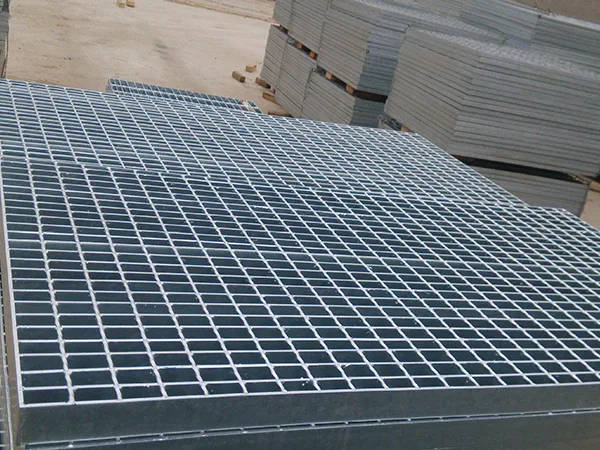
The amount of pollutants intercepted by a screen varies greatly with the selected bar spacing and water properties, generally based on the principle of not blocking water pumps and treatment equipment of water treatment plants.
The above are common specifications; actual ordered dimensions and tolerance requirements shall be confirmed against the layout drawing.
Bigger is not always better. The selection of hot-dip galvanized steel grating should be as economical as possible while meeting load requirements; over-thickening increases self-weight and cost and complicates installation. The product page offers a fuller comparison for galvanized grating; refer to it before deciding.
Basic Concepts of Screening Capacity of Hot-Dip Galvanized Steel Gratings
Below we first briefly explain the relevant concepts and basic construction to make the following parameters and sizing content easier to understand.
In drainage engineering,grating panelsare used to remove coarser suspended matter that could block pump units, pipes and valves, and to ensure normal operation of subsequent treatment facilities.
A steel grating screen consists of one (or more) sets of parallel metal bars and a frame; it is installed inclined at the inlet channel or at the inlet of the suction well of pumping stations, to intercept coarse suspended matter and impurities in sewage.
Once you grasp these basic concepts, the specifications and sizing recommendations that follow will be much easier to understand.
A practical tip for specification confirmation: write all four items - bearing bar specification, bearing bar center pitch, cross bar pitch and overall dimensions - into the purchase list at the same time; writing only one or two easily leads to delivery mismatches. The specification notation of hot-dip galvanized steel gratings is fully compared on the product pages; before ordering, number and check each panel against the layout drawing; the same applies to galvanized steel gratings.
Application Scenarios of Screening Capacity of Hot-Dip Galvanized Steel Gratings
Main applications are as follows:
Screens set before the treatment system of a sewage treatment plant should also ensure the whole sewage treatment system operates normally, without blocking treatment facilities or pipes. Therefore, coarse and fine screens can be set, with bar spacing generally 16-25mm, not exceeding 40mm at most. The amount of intercepted pollutants is related to regional conditions, the type of sewage channel system, sewage flow, bar spacing and other factors.
To ensure normal screen operation, in actual practice, 0.1-0.4 m is generally taken for municipal sewage. For industrial sewage, depending on bar spacing and cleaning intervals and other factors, a safety margin required for partial blockage should be reserved.
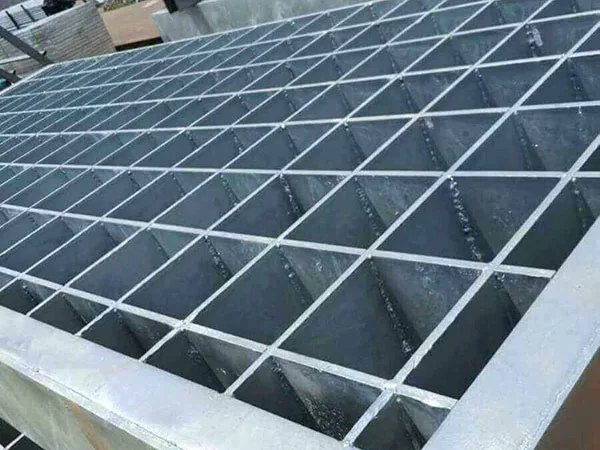
Manually cleaned screens: for domestic sewage treatment plants of small and medium-sized cities or where the amount of pollutants to be intercepted is small, manually cleaned screens can be used. Such screens are made of straight steel bars, generally placed at an inclination of 45-60 degrees to the horizontal; a smaller inclination makes cleaning easier but occupies more space.
For manually cleaned screens, the design area should adopt a larger safety factor, generally no less than twice the effective area of the inlet pipe or channel, to avoid overly frequent cleaning. For screens in the suction well of sewage pumping stations, special attention should be paid to the harm of harmful gases to operators, and effective precautions should be taken. An operating platform should be set in the screen chamber.
If your working conditions fall outside the above range, you can provide site photos and dimensions, and our technicians will help assess them.
What is most easily overlooked when reading specification tables is tolerances and end treatment. The length direction of hot-dip galvanized steel gratings usually has machining allowance; if embedded installation is used on site, trimming and corner-cutting requirements need to be stated in advance. Galvanized steel gratings are handled similarly in such details; it is recommended to mark them clearly on the drawings as well.
Supplementary Notes on Screening Capacity of Hot-Dip Galvanized Steel Gratings
The following aspects most need to be confirmed in advance in actual procurement and use:
For mechanically cleaned screens, the inclination is generally 60-70 degrees, sometimes 90 degrees. The flow area of mechanically cleaned screens should generally be no less than 1.2 times the effective area of the inlet pipe or channel.
Screen bars have circular, rectangular and square cross-sections; circular has better hydraulic conditions than square but lower stiffness. Rectangular-section bars are mostly used now. The channel where the screen is set should be of appropriate width so the flow maintains an appropriate velocity: on one hand sediment does not deposit at the channel bottom, and on the other hand the intercepted pollutants do not wash over the screen. Usually 0.4-0.9 m/s is adopted.
The above points can serve as a pre-purchase checklist; confirm each item before moving to the quotation stage.
Choosing a surface treatment is essentially a trade-off between initial investment and later maintenance. Requirements can be appropriately relaxed when hot-dip galvanized steel gratings are used in dry indoor environments, and raised accordingly outdoors or in humid environments. Galvanized steel grating selection can follow the same approach.
Further Reading: How to Use Galvanized Steel Gratings in Combination with Galvanized Steel Gratings
Galvanized steel gratings and galvanized steel gratings are different specification forms within the same product system; the selection logic is consistent with this article: first look at the nature of use, then determine specifications by span and load, and finally determine surface treatment by environment. The two may differ in corrosion protection and anti-slip requirements; it is recommended to specify them separately before ordering rather than writing one general technical requirement.
- For all product specifications and theoretical weights by series, visit Steel Grating Product Center
- To estimate cost by size and quantity, use Instant Quote PageSubmit Requirements
- To see how similar projects were executed, refer to Project Cases field applications
FAQ
What is most often overlooked during installation and acceptance?
First, bearing bars installed in the wrong direction reduce load capacity; second, insufficient fixing points or missing zinc touch-up paint; third, support beam spacing inconsistent with the layout drawing. These three items are most often overlooked on site.
How to choose between hot-dip galvanizing and cold galvanizing?
The two anti-corrosion mechanisms differ: hot-dip galvanizing immerses steel in molten zinc to form a metallurgically bonded coating, thick and long-lasting, suitable for outdoor and humid environments; cold galvanizing is electrochemical deposition with a thinner, more uniform appearance, suitable for dry indoor environments or applications requiring high dimensional precision.
Why do different manufacturers quote different weights for the same specifications?
The main difference lies in the actual measured thickness and tolerance control of the bearing bars. When bars are supplied at the lower tolerance limit, weight per unit area falls below the theoretical value, and load capacity drops accordingly. We recommend specifying thickness tolerance clearly when purchasing.
The above is for sizing and construction reference. To verify specific parameters or request a quotation, please visitInstant Quote Page, or contact our technical staff.
The above is general guidance. For a specific project, we still recommend submitting span, load class and service environment to our technicians for review. Steel grating is a load-bearing component; rework caused by wrong specification choices costs far more than the time spent on upfront calculation.