







This article focuses on galvanized steel grating, covering its standards and acceptance requirements, supplementary notes, and application scenarios, with practical tips after each section. If you are comparing solutions or preparing for procurement, check the items in the order presented; items on hot-dip galvanized steel grating can be confirmed against this article, adjusting for actual site conditions.
Standards and Acceptance Requirements of Galvanized Steel Grating
The main standard clauses and acceptance requirements involved are as follows:
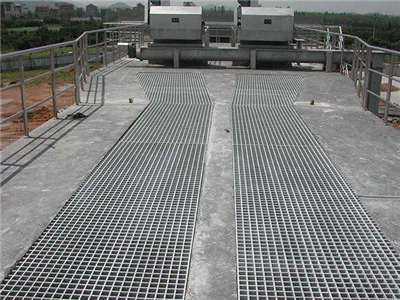
The load and deflection of galvanized steel grating shall be tested by the three-point bending method (or four-point bending method) with reference to GB/T14452-93, to test the load capacity of the grating and the relationship between line load and deflection, so as to verify design requirements and perform sampling inspection of grating products.
We recommend checking each clause above during acceptance and keeping the factory inspection records.
Material and surface treatment determine the durability of galvanized steel grating on site. Even for the same grating, treatment differs greatly between dry indoor use and coastal or chemical environments; the service environment should be stated as the primary condition during selection. The same judgment applies to hot-dip galvanized steel grating.
Supplementary Notes on Galvanized Steel Grating
The following aspects most need to be confirmed in advance in actual procurement and use:
Test Equipment
The above points can serve as a pre-purchase checklist; confirm each item before moving to the quotation stage.
Regarding corrosion protection, one thing is easily overlooked: on-site cutting and welding damage the original coating, and these areas need zinc touch-up after construction, otherwise rust often starts from the cut edges. Hot-dip galvanized steel grating has the same issue; it is best to include this in the technical requirements at the construction disclosure.
Application Scenarios of Galvanized Steel Grating
Typical applications mainly include the following categories, which can help you judge suitability for your project:
The test is performed on a hydraulic universal material testing machine with first-class accuracy and a load capacity at least 25% greater than the sample load requirement. Load measurement shall be accurate to 3%. The deflectometer or dial gauge used for deflection testing shall be accurate to 0.01mm.
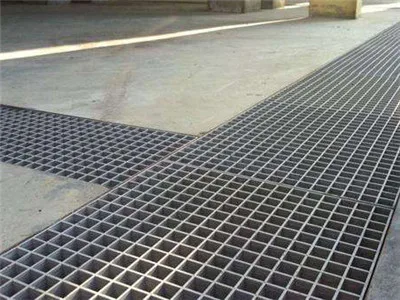
If your working conditions fall outside the above range, you can provide site photos and dimensions, and our technicians will help assess them.
Do not simply pursue high material grades. The material of galvanized steel grating should match the load requirements and service environment; over-specifying causes unnecessary cost increases. For hot-dip galvanized steel grating, refer to the product page and select according to actual working conditions.
Key Points of Galvanized Steel Grating
The following aspects most need to be confirmed in advance in actual procurement and use:
Specimen Preparation
The above points can serve as a pre-purchase checklist; confirm each item before moving to the quotation stage.
Choosing a surface treatment is essentially a trade-off between initial investment and later maintenance. Requirements can be relaxed for galvanized steel grating in dry indoor environments, but should be raised for outdoor or humid environments. Hot-dip galvanized steel grating can be selected with the same approach.
Galvanized Steel Grating Specifications
When manufacturing each specification or batch, the manufacturer may prepare grating load test specimens from the same material and manufacturing method, or cut them arbitrarily from products; the number of specimens may be determined by the manufacturer based on batch size or agreed by both parties. The three contact points between specimen and testing machine shall be flat, ensuring good contact with each bearing flat bar; the specimen must be machined flat.
Bigger specifications are not always better. The selection of galvanized steel grating should be as economical as possible while meeting load requirements; excessive thickening increases self-weight and cost and complicates installation. The product page provides more complete reference for hot-dip galvanized steel grating; refer to it before making a decision.
Specimen Dimensions
Specimen width: approx. 305mm.
Specimen lengths: 680mm and 1150mm.
Load Test
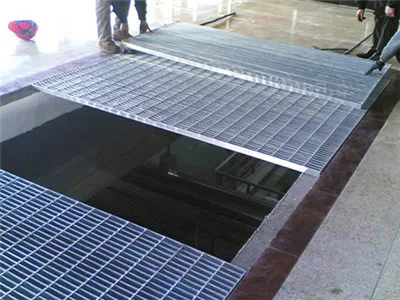
For a 680mm specimen, the support roller spacing is 600mm; for a 1150mm specimen, 1000mm; the support rollers shall be longer than the specimen width. The bending head of the testing machine applies load steadily to the middle of the specimen perpendicular to the bearing flat bars, and the bending head shall be longer than the specimen width. Before loading, ensure good contact between the support rollers, the head and every bearing flat bar. Measure the bending deflection of the specimen with a dial gauge, record the force gauge readings, and plot the load-deflection curve with an automatic recorder.
Data Processing
Line load test formula:
PL=P/W kN/m.............(C1)
Uniform load conversion formula:
Pu=1.6PL/L kN/m2.............(C2)
Where:
P----- force gauge reading, in kilonewtons (kN);
PL ----- line load, in kilonewtons per meter (kN/m);
Pu---- uniform load, in kilonewtons per square meter (kN/m2);
L ----- span (support roller spacing), in meters (m);
W ----- n/N, nominal specimen width, in meters (m);
n ----- number of bearing flat bars in the specimen;
N ----- number of bearing flat bars per meter of width. For example: with a bearing bar center pitch of 30mm, N=34/m; with a pitch of 20mm, N=51/m.
Actual parameters of the same model may vary slightly between manufacturers; acceptance shall be based on measured values. Spot checks of key dimensions of galvanized steel grating are recommended, especially for bulk deliveries. Corresponding parameters of hot-dip galvanized steel grating can be checked the same way, and any deviation should be communicated promptly.
Further reading: Selection points for hot-dip galvanized steel grating and hot-dip galvanized steel grating
Besides what this article covers, hot-dip galvanized steel grating is also common in actual projects. It shares similarities with this article's subject in structure and fabrication; for selection, check span, load and service environment in the same order. If both types of components are used in the same project, we recommend unifying material and surface treatment to avoid later galvanic corrosion or inconsistent appearance.
- For all product specifications and theoretical weights by series, visit Steel Grating Product Center
- To estimate cost by size and quantity, use Instant Quote PageSubmit Requirements
- To see how similar projects were executed, refer to Project Cases field applications
FAQ
Where can I find specific specifications?
our websiteProductsCommon specifications and theoretical weights are organized by series, also available in Instant Quote PageEstimate by size, or contact us directly for sizing advice.
Can the values in the article be applied directly?
Values in this article come from relevant standard clauses or common industry practice. For actual selection, recalculate based on site span, load class and service environment; direct copying is not recommended.
What information is needed for custom sizes?
Usually you need to provide the panel dimensions (length x width), bearing bar specs and direction, center-to-center pitch of bearing bars and cross bars, surface treatment, and special requirements such as cutouts, corner notches and banding. Site photos or sketches are even better.
The above is for sizing and construction reference. To verify specific parameters or request a quotation, please visitInstant Quote Page, or contact our technical staff.
Note that this article presents sizing approaches and general practice, and does not constitute a strength commitment for any specific project. For load-bearing safety-critical areas, the design drawings and on-site calculations shall prevail; contact our technical staff if in doubt.