







Applications of steel grating in actual projects are not complicated; the difficulty lies in matching specifications, material, and service environment. This article covers specification parameters, application scope and engineering fields, and basic concepts in turn; after reading, you will have a complete judgment framework for galvanized steel grating.
Steel Grating Specifications
Common specifications and corresponding parameters are summarized below; confirm each item before ordering:
Three key selection factors:Load (pedestrians, equipment, wheels), Span (clear distance between supports), Bearing Bar Specifications. The core rule is:The longer the span, the thicker or more closely spaced the bearing bars must be; at the same span, doubling the load requires significantly thicker bars.
| Load | Span | Recommended |
|---|---|---|
| Load Class | Span | Recommended Specifications |
| Pedestrian 3kN/m² | ≤1.0m | G255/30/100 |
| Pedestrian 3kN/m² | ≤1.5m | G303/30/100 |
| Equipment 5kN/m² | ≤1.0m | G325/30/100 |
| Heavy load ≥10kN/m² | ≤1.0m | G405/30/100 |
The above are common specifications; actual ordered dimensions and tolerance requirements shall be confirmed against the layout drawing.
What is most easily overlooked in spec tables are tolerances and end treatment. Steel grating usually has machining allowance in the length direction; if embedded installation is used on site, edge closing and corner notch requirements must be stated in advance. Hot-dip galvanized steel grating is handled similarly in these details; we recommend marking them clearly on the drawings as well.
Scope of Application & Engineering Fields
Typical applications mainly include the following categories, which can help you judge suitability for your project:
Rule of thumb: for pedestrian walkways (load about 3kN/m²) with a span of ≤1m, G255/30/100 can be used; for light equipment platforms with a 1m span, G303/30/100 is recommended; for heavy loads or spans above 1.5m, G325/30/100 or larger is advisable. If unsure, provide the load and span to the manufacturer and verify by finite element analysis or table lookup for safety.
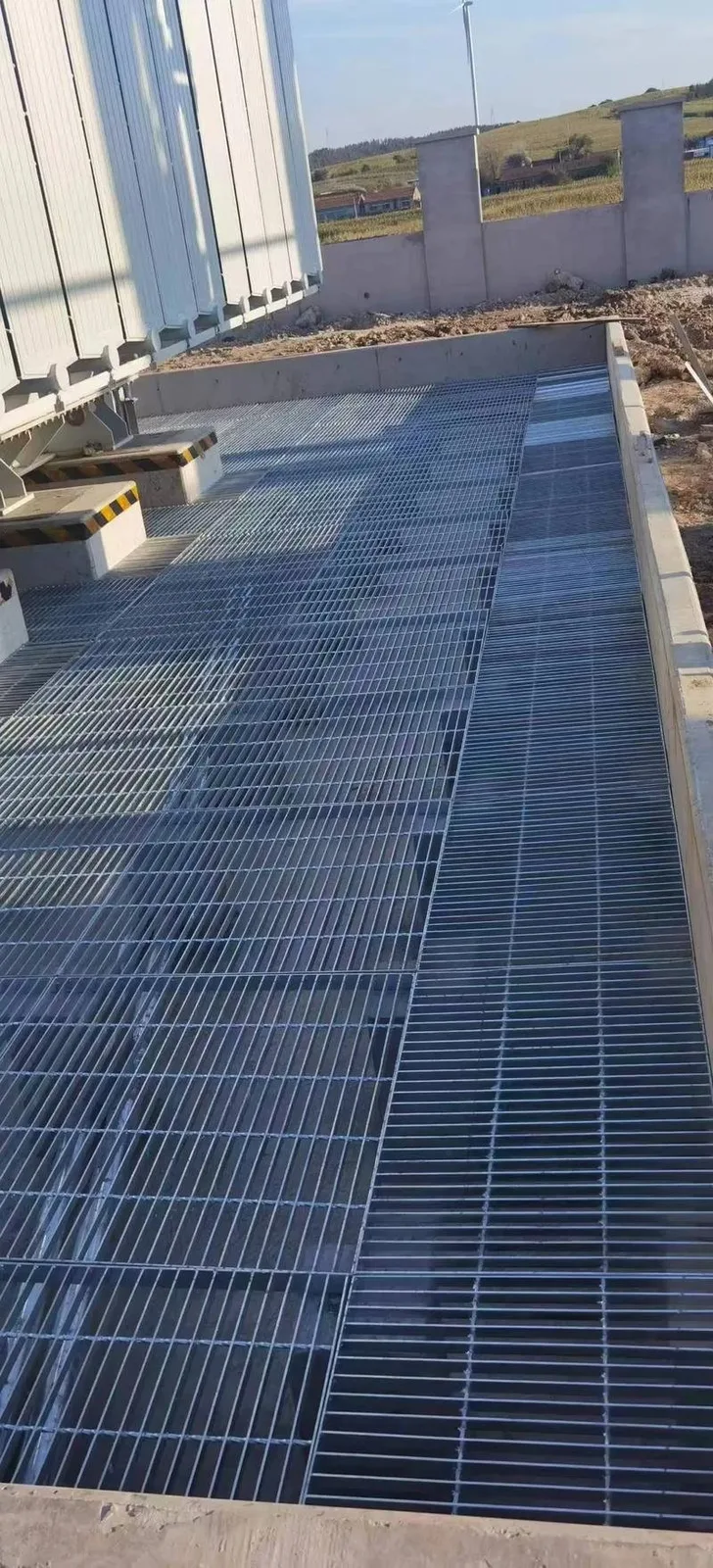
If your working conditions fall outside the above range, you can provide site photos and dimensions, and our technicians will help assess them.
Different areas of the same site often have different requirements. Take steel grating: main passages and corner areas, frequently used areas and occasional maintenance areas can be specified separately; the combination with galvanized grating should also be considered by zone, balancing safety and cost.
Further notes: Common combinations of galvanized grating and hot-dip galvanized steel grating
If a project uses both galvanized grating and hot-dip galvanized steel grating, we recommend planning them on the same layout drawing. This way edge closing, fixing and cutouts at junctions can be handled uniformly, avoiding dimension conflicts during installation and making later maintenance easier.
- For all product specifications and theoretical weights by series, visit Steel Grating Product Center
- To estimate cost by size and quantity, use Instant Quote PageSubmit Requirements
- To see how similar projects were executed, refer to Project Cases field applications
FAQ
Can the values in the article be applied directly?
Values in this article come from relevant standard clauses or common industry practice. For actual selection, recalculate based on site span, load class and service environment; direct copying is not recommended.
Where can I find specific specifications?
our websiteProductsCommon specifications and theoretical weights are organized by series, also available in Instant Quote PageEstimate by size, or contact us directly for sizing advice.
What maintenance is required during daily use?
Maintenance mainly involves periodically checking whether fasteners are loose, whether touch-up paint has peeled off, and whether the panel surface shows obvious deformation or rust. Issues found should be dealt with promptly; overall maintenance is minimal.
The above is for sizing and construction reference. To verify specific parameters or request a quotation, please visitInstant Quote Page, or contact our technical staff.
If you already have drawings or site dimensions, submit them directly and we will help verify specifications and layout, avoiding on-site cutting and rework caused by mismatched models. Without drawings, site photos and approximate dimensions are enough for an estimate.