







Regarding steel grating walkways and steel grating trench covers, this article explains their design, installation and fixing methods, and basic concepts item by item, aiming to give directly actionable ways of judging rather than just theory. If you have drawings or site dimensions at hand, you can check them against the points here one by one, and galvanized steel grating can follow the same order of judgment.
Application Scenarios of the Design of Steel Grating Walkways and Steel Grating Trench Covers
Main applications are as follows:
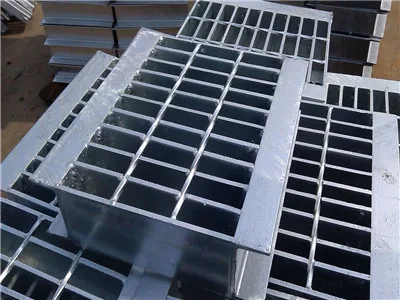
Design of steel grating walkways and steel grating trench covers.
Used for pedestrian walkways, roadways, parking lots on traffic roads, and steel grating trench covers on docks or building floors. Because loads and vehicle travel directions differ, their design and selection require special consideration.
If your working conditions fall outside the above range, you can provide site photos and dimensions, and our technicians will help assess them.
To judge whether steel grating walkways and steel grating trench covers can be used in a given place, three angles give a quick answer: whether corrosive media are present, whether pedestrians or vehicles pass over it, and roughly what the span is. Once these are clear, you can basically determine what specification and surface treatment galvanized steel grating needs.
Installation and Fixing Method
On-site construction generally follows the steps and technical requirements below; complete the technical disclosure before starting work:
Used as transverse trench covers on roads. When the vehicle travel direction is parallel to the flat bearing bars, not only wheel pressure and impact must be considered, but also the risk of the steel grating trench cover bouncing or shifting must be prevented; the cover must be fixed to the support frame or support beam (by welding or bolting).
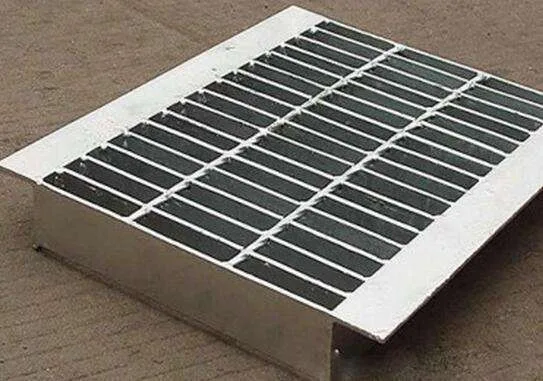
After installation, check each panel's fixing points and flatness; put into use only after confirming no warping or looseness.
The installation stage has the greatest impact on later user experience. Steel grating walkways and trench covers must not be laid in the wrong direction: the flat bearing bars should run along the main load direction, a point most easily overlooked on site. The number of fasteners must also be complete per the layout drawing; a single missing one can cause local loosening. This requirement applies equally to hot-dip galvanized steel grating.
Scope of Application & Engineering Fields
Appendix B gives the selection of ordinary steel grating trench covers. For roadway covers not listed in the table or with special requirements, design can be carried out through strength and deflection calculations.
The applicable range of steel grating walkways and steel grating is actually broader than many people think, from industrial platforms to municipal landscaping. The difference is that industrial scenarios focus more on load capacity and anti-corrosion, while municipal scenarios also consider appearance, anti-theft, and pedestrian safety. Common practices for hot-dip galvanized steel grating in these scenarios can be found on the case page.
Further notes: How to combine galvanized grating and hot-dip galvanized steel grating in use
Besides what this article covers, galvanized grating is also common in actual projects. It shares similarities with this article's subject in structure and fabrication; for selection, check span, load and service environment in the same order. If both types of components are used in the same project, we recommend unifying material and surface treatment to avoid later galvanic corrosion or inconsistent appearance.
- For all product specifications and theoretical weights by series, visit Steel Grating Product Center
- To estimate cost by size and quantity, use Instant Quote PageSubmit Requirements
- To see how similar projects were executed, refer to Project Cases field applications
FAQ
What is most often overlooked during installation and acceptance?
First, bearing bars installed in the wrong direction reduce load capacity; second, insufficient fixing points or missing zinc touch-up paint; third, support beam spacing inconsistent with the layout drawing. These three items are most often overlooked on site.
What maintenance is required during daily use?
Maintenance mainly involves periodically checking whether fasteners are loose, whether touch-up paint has peeled off, and whether the panel surface shows obvious deformation or rust. Issues found should be dealt with promptly; overall maintenance is minimal.
What information is needed for custom sizes?
Usually you need to provide the panel dimensions (length x width), bearing bar specs and direction, center-to-center pitch of bearing bars and cross bars, surface treatment, and special requirements such as cutouts, corner notches and banding. Site photos or sketches are even better.
The above is for sizing and construction reference. To verify specific parameters or request a quotation, please visitInstant Quote Page, or contact our technical staff.
The above is general guidance. For a specific project, we still recommend submitting span, load class and service environment to our technicians for review. Steel grating is a load-bearing component; rework caused by wrong specification choices costs far more than the time spent on upfront calculation.