







This article focuses on steel grating walkways and steel grating and explains, in turn, the design of steel grating walkways and trench covers, installation and fixing methods, and basic concepts, with practical advice added after each section. If you are comparing options or preparing a purchase, you can check the points in order; the parts concerning galvanized steel grating can be confirmed against the entries here, and any mismatch with site conditions can be adjusted accordingly.
Application Scenarios for the Design of Steel Grating Walkways and Steel Grating Trench Covers
Main applications are as follows:
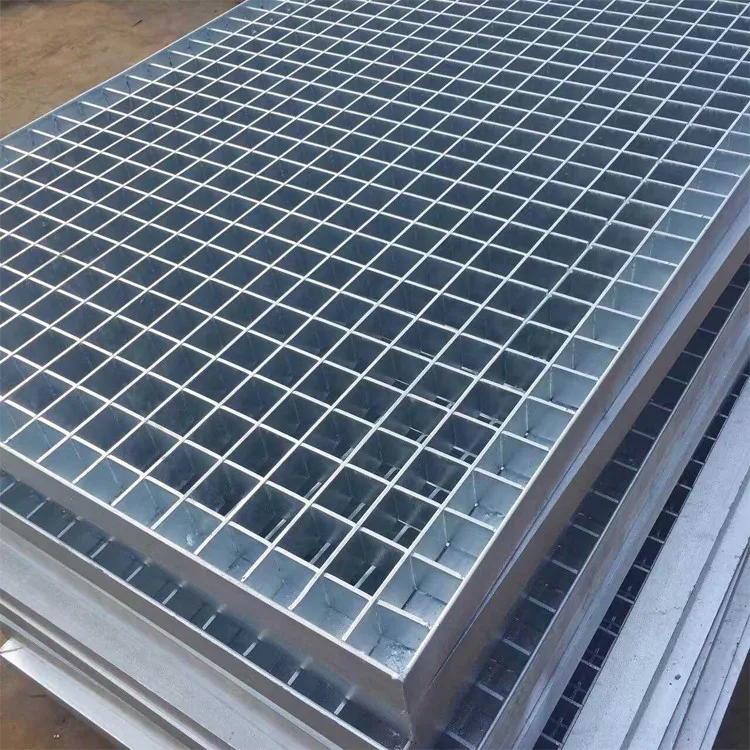
Steel grating trench covers used on pavements, roadways, parking lots, terminals or building floors should be specially considered in design and selection because of differences in load and traffic direction.
If your working conditions fall outside the above range, you can provide site photos and dimensions, and our technicians will help assess them.
Bigger specifications are not always better. Selection of steel grating walkways and steel grating should be as economical as possible while still meeting load requirements; over-thickening increases self-weight and cost and complicates installation. A more complete comparison of galvanized steel grating is given on the product page and can be consulted before deciding.
Installation and Fixing Method
Key points for construction and fixing are as follows:
When used as a cross trench cover on a road (traffic direction parallel to the bearing bars), not only wheel pressure and impact must be considered, but also the risk of the steel grating trench cover bouncing or shifting must be prevented; the cover must be fixed to the support frame or support beam (welded or bolted).
After installation, check each panel's fixing points and flatness; put into use only after confirming no warping or looseness.
For the installation sequence, lay out first and fix afterwards; never alter the layout as you go. Once the layout drawing for steel grating walkways and steel grating is confirmed, avoid random cutting on site; if adjustments are really needed, the fixing and edge-banding of galvanized steel grating should be adjusted at the same time to avoid leaving a loosening hazard.
Further reading: Sizing reference for galvanized grating and hot-dip galvanized steel grating
If a project uses both galvanized grating and hot-dip galvanized steel grating, we recommend planning them on the same layout drawing. This way edge closing, fixing and cutouts at junctions can be handled uniformly, avoiding dimension conflicts during installation and making later maintenance easier.
- For all product specifications and theoretical weights by series, visit Steel Grating Product Center
- To estimate cost by size and quantity, use Instant Quote PageSubmit Requirements
- To see how similar projects were executed, refer to Project Cases field applications
FAQ
Can the values in the article be applied directly?
Values in this article come from relevant standard clauses or common industry practice. For actual selection, recalculate based on site span, load class and service environment; direct copying is not recommended.
What is most often overlooked during installation and acceptance?
First, bearing bars installed in the wrong direction reduce load capacity; second, insufficient fixing points or missing zinc touch-up paint; third, support beam spacing inconsistent with the layout drawing. These three items are most often overlooked on site.
What maintenance is required during daily use?
Maintenance mainly involves periodically checking whether fasteners are loose, whether touch-up paint has peeled off, and whether the panel surface shows obvious deformation or rust. Issues found should be dealt with promptly; overall maintenance is minimal.
The above is for sizing and construction reference. To verify specific parameters or request a quotation, please visitInstant Quote Page, or contact our technical staff.
The above is general guidance. For a specific project, we still recommend submitting span, load class and service environment to our technicians for review. Steel grating is a load-bearing component; rework caused by wrong specification choices costs far more than the time spent on upfront calculation.