







About I-type steel grating, this article explains in order its specifications, classification and uses, giving directly executable judgment methods rather than only principles. If you have drawings or site dimensions, check the key points item by item; hot-dip galvanized steel gratings can follow the same sequence.
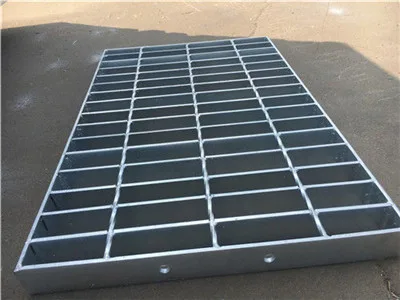
I-type steel grating is an open steel member composed of I-type flat bars and cross bars combined orthogonally at certain spacing and fixed by welding or press-locking; cross bars are generally twisted square bars, with round bars or flat bars also possible, in carbon steel and stainless steel.
Specifications of I-Type Steel Grating
Common specifications and corresponding parameters are summarized below; confirm each item before ordering:
- Flat bar height (or width) and thickness of I-type steel grating: flat bar height is usually 20mm, 25mm, 30mm, 32mm, 35mm, 40mm, 45mm, 50mm, etc.; grating flat bar thickness includes 3mm, 4mm, 5mm.
- Surface treatments of I-type steel grating: hot-dip galvanizing, cold galvanizing, electroplating, spray painting, anti-rust oil dipping, PVC-dip coating, untreated.
- Bearing bar pitch of I-type steel grating: the center distance of adjacent bearing flat bars, commonly 30mm and 40mm, sometimes 60mm.
- Cross bar pitch of I-type steel grating: the center distance of adjacent cross bars, usually 50mm and 100mm; produced on request.
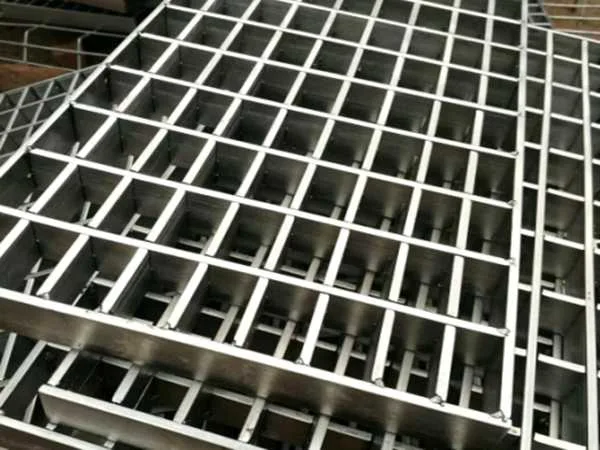
Packaging of I-type steel grating:
I-type steel grating is usually packaged in bulk or bundled with packing straps, depending on the customer; everything is for customer convenience and protection from damage in transit.
The above are common specifications; actual ordered dimensions and tolerance requirements shall be confirmed against the layout drawing.
The most easily overlooked items in a specification table are tolerance and end treatment. I-type steel grating usually has machining allowance in length; if the site uses recessed installation, state the trimming and corner-cutting requirements in advance. Galvanized grating is handled similarly; mark these details clearly on drawings.
Classification of I-Type Steel Grating
Common classification methods are as follows:
- By manufacturing method: welded steel grating and press-locked steel grating.
- By material: ordinary carbon steel grating and stainless steel grating.
- By surface treatment: hot-dip galvanized steel grating and spray-painted steel grating.
- By application: platform steel grating, trench covers, compound steel grating, press-locked steel grating and steel grating ceilings.
I-type steel grating is easy to install, light, strong in load bearing and impact resistance, bends rather than breaks, drains well, and is attractive, durable and corrosion-resistant after hot-dip galvanizing, with advantages unmatched by cast iron covers. Hinged or hook connections make opening easy and provide an anti-theft function.
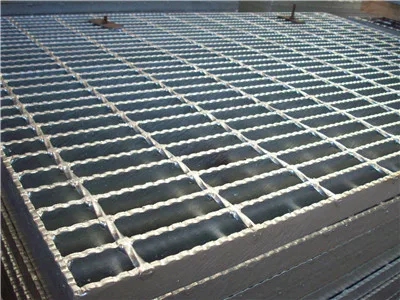
Determine the category first and then the specific model; this saves detours and makes comparison with other materials easier.
Material and surface treatment determine the field durability of I-type steel grating. For the same steel grating, treatments differ greatly between dry indoor use and coastal or chemical environments; make the service environment the primary condition in selection. The same judgment applies to galvanized grating.
Uses of I-Type Steel Grating
Main applications are as follows:
I-type steel grating suits alloy, building materials, power stations, boilers, shipbuilding, petrochemicals, chemicals and general industrial plants, municipal construction and other industries, with ventilation, light transmission, slip resistance, strong load capacity, attractive durability, easy cleaning and simple installation. Steel grating has been widely used in various industries at home and abroad, mainly as industrial platforms, stair treads, handrails, walkway floors, railway bridge walkways, high-altitude tower platforms, drainage trench covers, manhole covers, road grilles, multi-story parking lots, and fences of institutions, schools, factories, enterprises, sports fields, gardens and villas; also as exterior windows and balcony railings of residences and as guardrails of expressways and railways.
If your working conditions fall outside the above range, you can provide site photos and dimensions, and our technicians will help assess them.
After installation, an overall check is recommended: whether panels are warped, fixings are complete, and height differences between adjacent panels are obvious. Such issues with I-type steel grating cost least to fix at the acceptance stage and are troublesome after commissioning. Acceptance points for galvanized grating can follow the same criteria.
Further notes: Common combinations of hot-dip galvanized steel grating and galvanized grating
If a project uses both hot-dip galvanized steel grating and galvanized grating, we recommend planning them on the same layout drawing. This way edge closing, fixing and cutouts at junctions can be handled uniformly, avoiding dimension conflicts during installation and making later maintenance easier.
- For all product specifications and theoretical weights by series, visit Steel Grating Product Center
- To estimate cost by size and quantity, use Instant Quote PageSubmit Requirements
- To see how similar projects were executed, refer to Project Cases field applications
FAQ
Can the values in the article be applied directly?
Values in this article come from relevant standard clauses or common industry practice. For actual selection, recalculate based on site span, load class and service environment; direct copying is not recommended.
What maintenance is required during daily use?
Maintenance mainly involves periodically checking whether fasteners are loose, whether touch-up paint has peeled off, and whether the panel surface shows obvious deformation or rust. Issues found should be dealt with promptly; overall maintenance is minimal.
Why do different manufacturers quote different weights for the same specifications?
The main difference lies in the actual measured thickness and tolerance control of the bearing bars. When bars are supplied at the lower tolerance limit, weight per unit area falls below the theoretical value, and load capacity drops accordingly. We recommend specifying thickness tolerance clearly when purchasing.
The above is for sizing and construction reference. To verify specific parameters or request a quotation, please visitInstant Quote Page, or contact our technical staff.
Note that this article presents sizing approaches and general practice, and does not constitute a strength commitment for any specific project. For load-bearing safety-critical areas, the design drawings and on-site calculations shall prevail; contact our technical staff if in doubt.