







Many projects focus only on price when purchasing steel grating, overlooking specification matching and anti-corrosion requirements, which often leads to rework. This article lists the conditions to confirm in the order of correct installation, incorrect installation, and on-site installation tips, and explains how to make trade-offs under common conditions; the sections on hot-dip galvanized steel grating can be used directly as a reference for technical disclosure.
Welded steel grating consists of flat bearing barsBearing Bar and cross bars (twisted square bars) welded together, with panel loads carried almost entirely by the bearing bars. When installing, the bar arrangement direction must follow the span direction of the panel - i.e., the line between the two supporting beams. If installed the wrong way, the bars do not bear on the beams, the load shifts to the cross bars, and capacity may fall to a fraction of the design value. One correct diagram and one incorrect diagram below clarify the differences and consequences of the two installation methods.
1. Correct Installation (Bearing Bars Along the Span)
On-site construction generally follows the steps and technical requirements below; complete the technical disclosure before starting work:
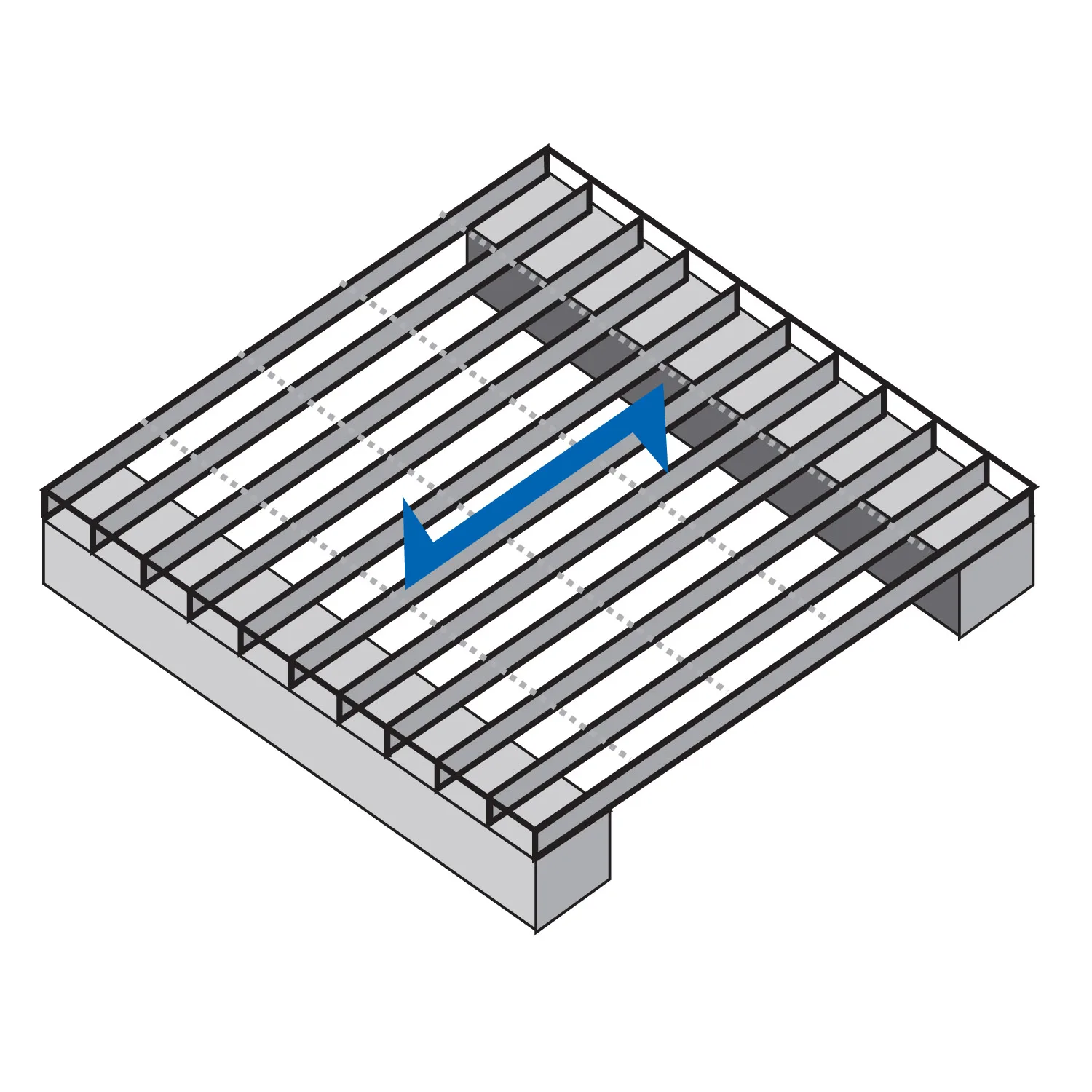
- Bar ends must rest on the bearing surface of the support beams; the shorter the unsupported overhang, the better
- Fix panels to each other and to beams with grating clips or welding to prevent slipping underfoot
- Large platforms should be laid according to the direction marks on the layout drawing to avoid mixing panel directions.
After installation, check each panel's fixing points and flatness; put into use only after confirming no warping or looseness.
What is most easily overlooked in spec tables are tolerances and end treatment. Steel grating usually has machining allowance in the length direction; if embedded installation is used on site, edge closing and corner notch requirements must be stated in advance. Hot-dip galvanized steel grating is handled similarly in these details; we recommend marking them clearly on the drawings as well.
2. Incorrect Installation (Bearing Bars Across the Span)
Key points for construction and fixing are as follows:
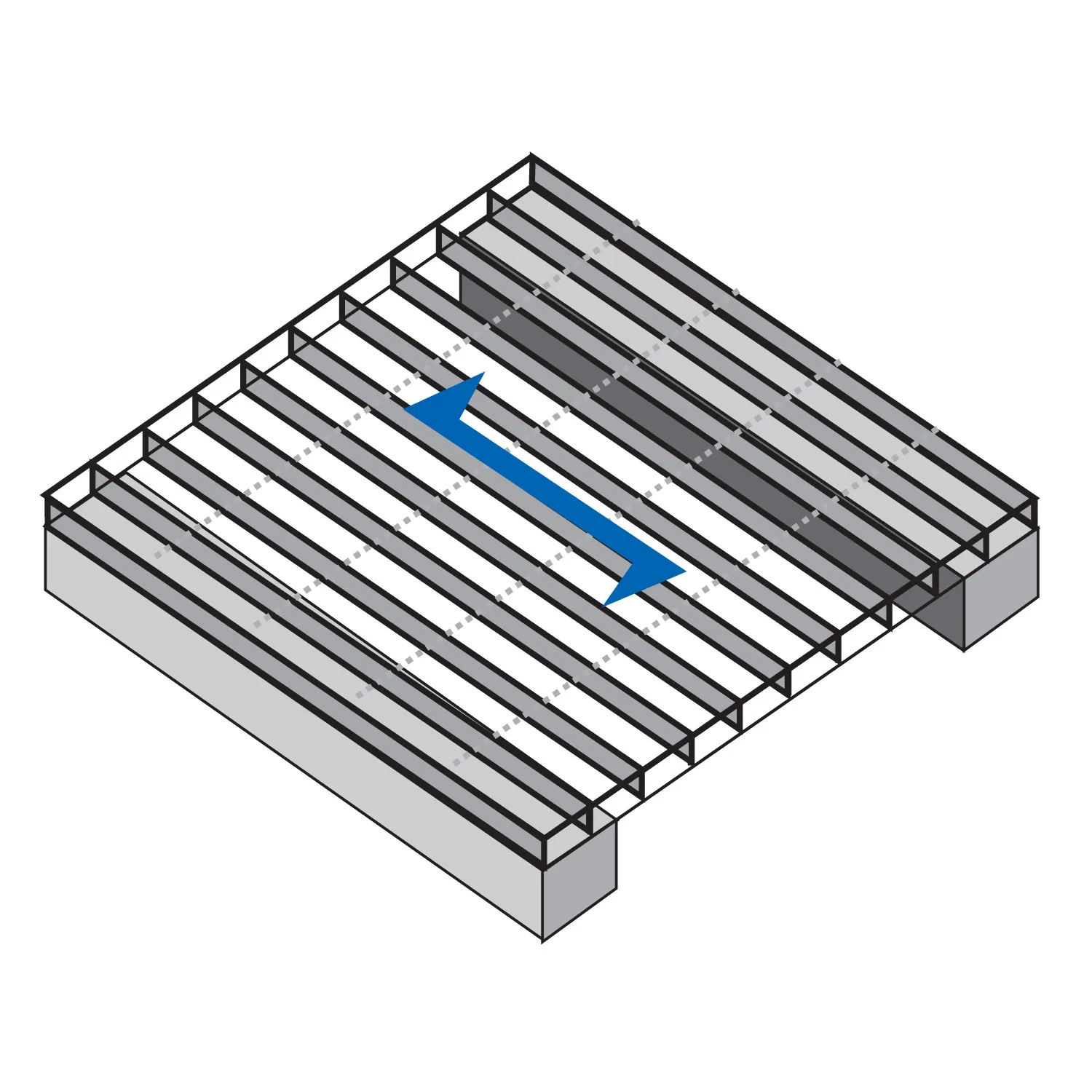
- Deflection increases noticeably and the panel trembles underfoot
- Cross bars are not designed load-bearing members; long-term overload easily cracks weld points and sags the panels
- Tolerance accumulation causes panel misalignment and loosening underfoot, leaving safety hazards.
| Comparison Item | Correct (bars along the span) | Incorrect (bars across the span) |
|---|---|---|
| Bearing bars vs. span | direction aligned | direction perpendicular |
| Bearing bar support | both ends on beams | middle suspended |
| Load path | bearing bars to beams (short, stable) | carried by cross bars (non-load-bearing) |
| Actual load capacity | close to design value | significantly reduced |
| On-site performance | flat, no vibration | trembling, sagging, loosening |
After installation, check each panel's fixing points and flatness; put into use only after confirming no warping or looseness.
Installation most affects later service experience. Steel grating must not be laid in the wrong direction; the bearing bars should align with the main load direction - the point most easily overlooked on site. The number of fasteners should also match the layout drawing; missing even one can cause local loosening. The same applies to hot-dip galvanized steel grating.
3. On-Site Installation Tips
On-site construction generally follows the steps and technical requirements below; complete the technical disclosure before starting work:
(1) Verify the bearing bar direction marks on the layout drawing before laying; (2) Beam tops should be flat, with bar-end bearing length not less than 25mm; (3) Fix each panel at at least 4 points (four corners) and leave expansion allowance at the free end; (4) Use stainless steel or hot-dip galvanized clips to prevent loosening; (5) During acceptance, walk on every panel to check for vibration or unusual noise. Remember the rule:Bearing bars run along the span, with both ends resting on the beams.
After installation, check each panel's fixing points and flatness; put into use only after confirming no warping or looseness.
Actual parameters of the same model may vary slightly between manufacturers; acceptance shall be based on measured values. We recommend sampling key steel grating dimensions, especially for bulk deliveries. Corresponding parameters of hot-dip galvanized steel grating can be checked the same way; communicate promptly if deviations are found.
Further notes: Common combinations of hot-dip galvanized steel grating and hot-dip galvanized steel grating
Besides what this article covers, hot-dip galvanized steel grating is also common in actual projects. It shares similarities with this article's subject in structure and fabrication; for selection, check span, load and service environment in the same order. If both types of components are used in the same project, we recommend unifying material and surface treatment to avoid later galvanic corrosion or inconsistent appearance.
- For all product specifications and theoretical weights by series, visit Steel Grating Product Center
- To estimate cost by size and quantity, use Instant Quote PageSubmit Requirements
- To see how similar projects were executed, refer to Project Cases field applications
FAQ
Where can I find specific specifications?
our websiteProductsCommon specifications and theoretical weights are organized by series, also available in Instant Quote PageEstimate by size, or contact us directly for sizing advice.
Can the values in the article be applied directly?
Values in this article come from relevant standard clauses or common industry practice. For actual selection, recalculate based on site span, load class and service environment; direct copying is not recommended.
What information is needed for custom sizes?
Usually you need to provide the panel dimensions (length x width), bearing bar specs and direction, center-to-center pitch of bearing bars and cross bars, surface treatment, and special requirements such as cutouts, corner notches and banding. Site photos or sketches are even better.
The above is for sizing and construction reference. To verify specific parameters or request a quotation, please visitInstant Quote Page, or contact our technical staff.
If you already have drawings or site dimensions, submit them directly and we will help verify specifications and layout, avoiding on-site cutting and rework caused by mismatched models. Without drawings, site photos and approximate dimensions are enough for an estimate.