







Many projects focus only on price when purchasing galvanized steel grating and overlook specification matching and corrosion protection, which often leads to rework later. This article lists the conditions to confirm one by one - sun exposure performance, material and corrosion requirements, and basic concepts - and explains how to choose under common working conditions. The parts concerning hot-dip galvanized steel grating can be used directly as a reference for technical briefings.
Performance Features of Galvanized Steel Grating Under Sun Exposure
Main features can be summarized as follows:
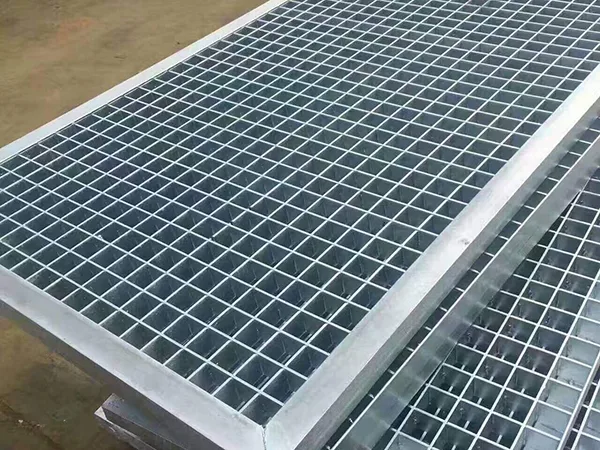
Hot-dip galvanized steel grating is now widely used and fundamentally solves the corrosion problems that affect traditional metal, wood and plastic products. Can it withstand sun exposure? Preferably not: its UV resistance is only moderate. Long-term exposure to direct sunlight can cause the surface resin to degrade and expose the inner glass fibre, which affects overall appearance but not strength. UV resistance can be improved in the factory by adding a 0.5mm resin-rich surface layer and UV absorbers.
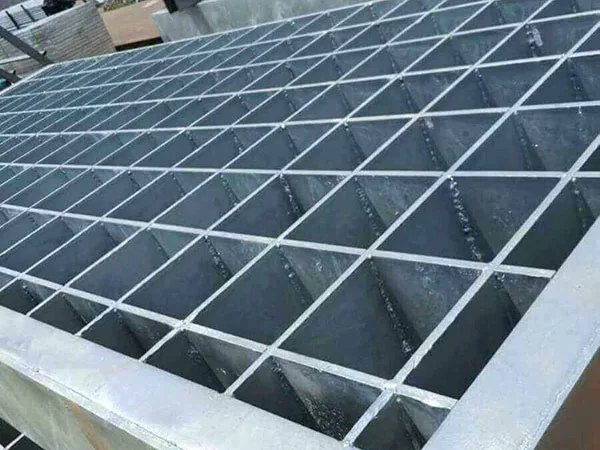
Overall, selection should weigh span, load and service environment together.
Regarding corrosion protection, one thing is easily overlooked: on-site cutting and welding damage the original coating, and these areas need zinc touch-up after construction, otherwise rust often starts from the cut edges. Hot-dip galvanized steel grating has the same issue; it is best to include this in the technical requirements at the construction disclosure.
Material and Anti-Corrosion Requirements
Material and surface treatment are key to service life. Common practices and suitable environments are as follows:
Good hot-dip galvanized grating has a smooth, bright surface with a pleasant feel to the touch. A few small bubbles are actually a good sign: they indicate a better-quality material, since high-grade resin has a higher density and produces fewer small bubbles.
A load test can be carried out on hot-dip galvanized grating to check whether it deforms under load and to assess its load capacity. A bright appearance indicates more resin and less filler, i.e. a well-balanced mix. A dull, flat sound when tapped means less resin and more calcium powder, and relatively poor grating quality.
Once material and surface treatment are decided, we recommend writing zinc coating thickness and appearance requirements into the technical agreement.
Material and surface treatment determine the durability of galvanized steel grating on site. The same grating can require very different treatments in a dry indoor area versus a coastal or chemical environment, so the service environment should be stated as the primary condition during selection. The same applies to hot-dip galvanized steel grating.
Further reading: Sizing reference for hot-dip galvanized steel grating and hot-dip galvanized steel grating
In engineering, hot-dip galvanized steel grating is often used together with the components mentioned in this article. The two differ in load carrying and installation practices; when combining them, pay special attention to the connection of support conditions and fixing methods, as junction treatment is often where problems arise. For unified drawings, submit dimensions of both types and our technicians will process them under the same layout logic.
- For all product specifications and theoretical weights by series, visit Steel Grating Product Center
- To estimate cost by size and quantity, use Instant Quote PageSubmit Requirements
- To see how similar projects were executed, refer to Project Cases field applications
FAQ
Where can I find specific specifications?
our websiteProductsCommon specifications and theoretical weights are organized by series, also available in Instant Quote PageEstimate by size, or contact us directly for sizing advice.
Can the values in the article be applied directly?
Values in this article come from relevant standard clauses or common industry practice. For actual selection, recalculate based on site span, load class and service environment; direct copying is not recommended.
How to choose between hot-dip galvanizing and cold galvanizing?
The two anti-corrosion mechanisms differ: hot-dip galvanizing immerses steel in molten zinc to form a metallurgically bonded coating, thick and long-lasting, suitable for outdoor and humid environments; cold galvanizing is electrochemical deposition with a thinner, more uniform appearance, suitable for dry indoor environments or applications requiring high dimensional precision.
The above is for sizing and construction reference. To verify specific parameters or request a quotation, please visitInstant Quote Page, or contact our technical staff.
The above is general guidance. For a specific project, we still recommend submitting span, load class and service environment to our technicians for review. Steel grating is a load-bearing component; rework caused by wrong specification choices costs far more than the time spent on upfront calculation.