







Many projects focus only on price when purchasing steel grating, ignoring specification matching and anti-corrosion requirements, which often leads to rework. This article lists, in the order of solutions, typical application scenarios, and basic concepts, the conditions to confirm one by one, and explains how to make trade-offs under common working conditions; the content related to galvanized steel grating can be used directly as technical disclosure reference.
- Cutting, welding and drilling damage the zinc layer; exposed areas rust first
- Long-term exposure to standing water, dust accumulation, or acid-alkali atmospheres in chemical plants
- Zinc coating too thin (cutting corners on materials).
| Position | Cause | Solution |
|---|---|---|
| Rust location | Cause | Treatment |
| Cut edges / weld points | Zinc layer damaged | Touch up with zinc-rich paint |
| Standing water on panel | Long-term moisture | Improve drainage |
| Overall rusting | Zinc coating too thin | Replace or re-galvanize |
Solutions
The following aspects most need to be confirmed in advance in actual procurement and use:
When rust spots appear, first remove rust with a wire brush, then seal with epoxy zinc-rich paint or cold galvanizing coating; for major projects, choose thicker galvanizing (≥85μm) or 304/316 stainless steel. When purchasing, spot-check the zinc layer with a thickness gauge to avoid "fake galvanizing" at the source.
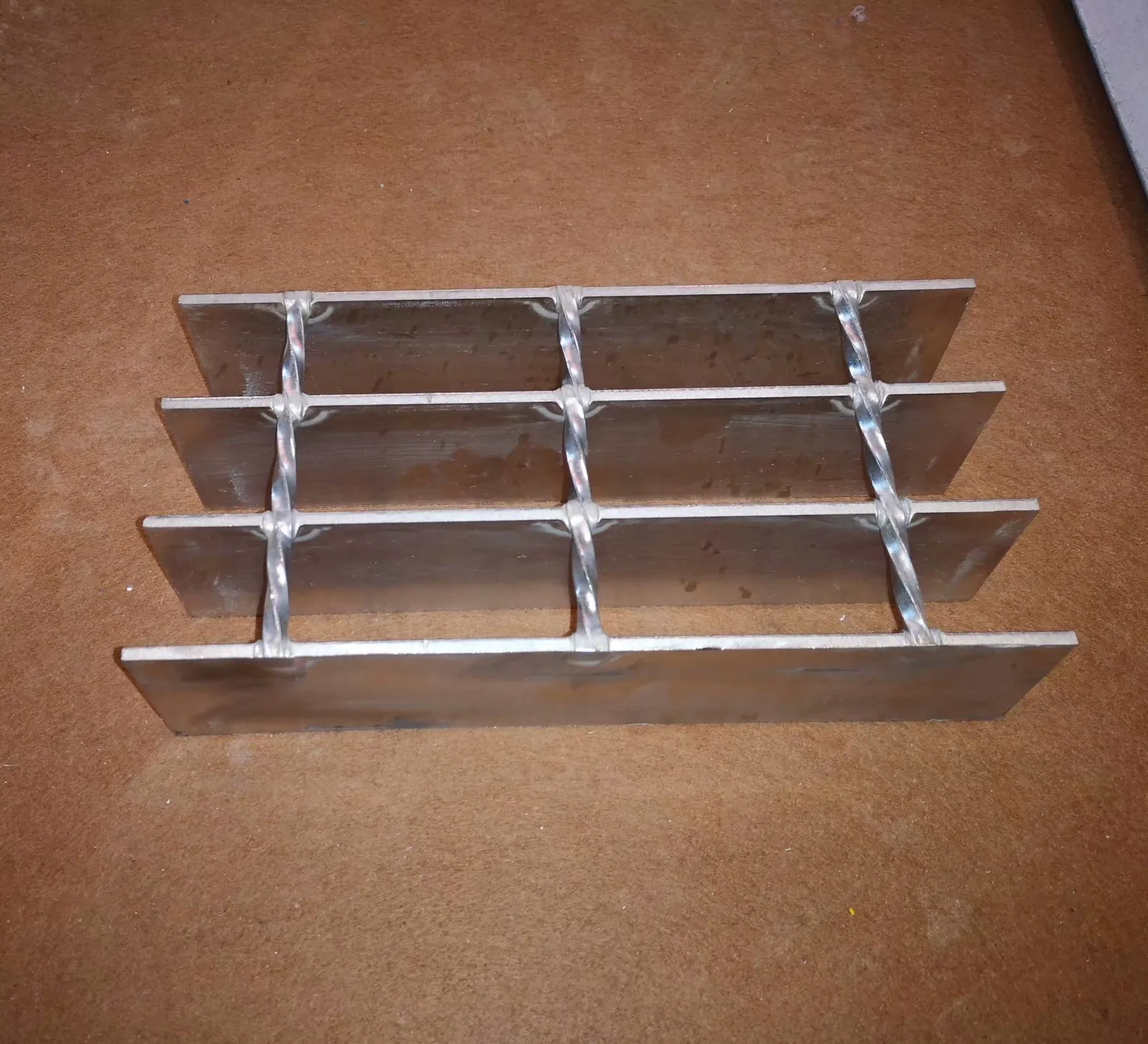
The above points can serve as a pre-purchase checklist; confirm each item before moving to the quotation stage.
For material selection, do not simply pursue high grades. The material of steel grating should match load requirements and service environment; over-specifying materials causes unnecessary cost increases. For hot-dip galvanized steel grating, refer to the product page for the corresponding treatment and choose according to actual working conditions.
Typical Applications
Typical applications mainly include the following categories, which can help you judge suitability for your project:
- Industrial Platforms & Maintenance Walkways: equipment platforms and inspection passages in power plants, chemical plants and steel-structure workshops;
- Municipal & Landscape: road drainage trench covers, rainwater grates, tree grates, park boardwalks;
- Transportation & Ports: wharf trestles, multi-story parking garage lanes, railway bridge walkways;
- Environmental & Water Treatment: walkways in wastewater treatment plants, tank platforms, screening machine platforms;
- Others: elevated tower platforms, stair treads, fences and railings, etc.
If your working conditions fall outside the above range, you can provide site photos and dimensions, and our technicians will help assess them.
The application range of steel grating is actually wider than many people think, from industrial platforms to municipal landscaping. The difference: industrial scenarios focus more on load capacity and corrosion protection, while municipal scenarios also consider appearance, anti-theft and pedestrian safety. Common practices for hot-dip galvanized steel grating in these scenarios can be viewed on the case page.
Key Conditions to Confirm During Selection
- First clarify the span and support beam spacing to determine the required series;
- Then check load requirements by usage type (pedestrian, maintenance, vehicular);
- Finally, determine the surface treatment by service environment (dry indoor, outdoor, coastal, chemical).
A practical tip for confirming specifications: write the bearing bar size, bearing bar center pitch, cross bar pitch and overall dimensions into the purchase list together; specifying only one or two items easily leads to goods mismatch. The specification marking of steel grating is fully cross-referenced on the product page; before ordering, check each panel against the layout drawing by number - the same applies to hot-dip galvanized steel grating.
Further notes: Common combinations of galvanized grating and hot-dip galvanized steel grating
If a project uses both galvanized grating and hot-dip galvanized steel grating, we recommend planning them on the same layout drawing. This way edge closing, fixing and cutouts at junctions can be handled uniformly, avoiding dimension conflicts during installation and making later maintenance easier.
- For all product specifications and theoretical weights by series, visit Steel Grating Product Center
- To estimate cost by size and quantity, use Instant Quote PageSubmit Requirements
- To see how similar projects were executed, refer to Project Cases field applications
FAQ
What information is needed for custom sizes?
Usually you need to provide the panel dimensions (length x width), bearing bar specs and direction, center-to-center pitch of bearing bars and cross bars, surface treatment, and special requirements such as cutouts, corner notches and banding. Site photos or sketches are even better.
What maintenance is required during daily use?
Maintenance mainly involves periodically checking whether fasteners are loose, whether touch-up paint has peeled off, and whether the panel surface shows obvious deformation or rust. Issues found should be dealt with promptly; overall maintenance is minimal.
What is most often overlooked during installation and acceptance?
First, bearing bars installed in the wrong direction reduce load capacity; second, insufficient fixing points or missing zinc touch-up paint; third, support beam spacing inconsistent with the layout drawing. These three items are most often overlooked on site.
The above is for sizing and construction reference. To verify specific parameters or request a quotation, please visitInstant Quote Page, or contact our technical staff.
If you already have drawings or site dimensions, submit them directly and we will help verify specifications and layout, avoiding on-site cutting and rework caused by mismatched models. Without drawings, site photos and approximate dimensions are enough for an estimate.