







On hot-dip galvanized steel grating, this article covers the standard and acceptance requirements, basic concepts of hot-dip galvanized steel grating, and basic concepts in turn, giving actionable criteria rather than theory alone. Those with drawings or site dimensions can check against the key points; hot-dip galvanized steel grating can follow the same order.
Standard and Acceptance Requirements for Hot-Dip Galvanized Steel Grating
The standards and inspection items to check are as follows:
The surface quality of galvanized steel grating can show defects such as uneven color, exposed white spots, impurities, blisters (surface, middle, bottom), delamination, thickness deviation, insufficient curing, resin-rich layers, cracking (caused by curing, resin richness, or demolding), pin defects, warping, and repair marks, so a strict quality inspection standard system must be established. A prominent problem in the domestic FRP grating industry is excessive focus on sample quality while neglecting overall product quality, with delivered goods differing greatly from samples.
We recommend checking each clause above during acceptance and keeping the factory inspection records.
Choosing a surface treatment is essentially balancing initial investment against later maintenance. Requirements for hot-dip galvanized steel grating can be appropriately relaxed in dry indoor environments, and raised accordingly outdoors or in humid environments. The selection of hot-dip galvanized steel grating can follow the same logic.
Basic Concepts of Hot-Dip Galvanized Steel Grating
This section first clarifies the basic concepts, structural forms and common names, laying the groundwork for what follows.
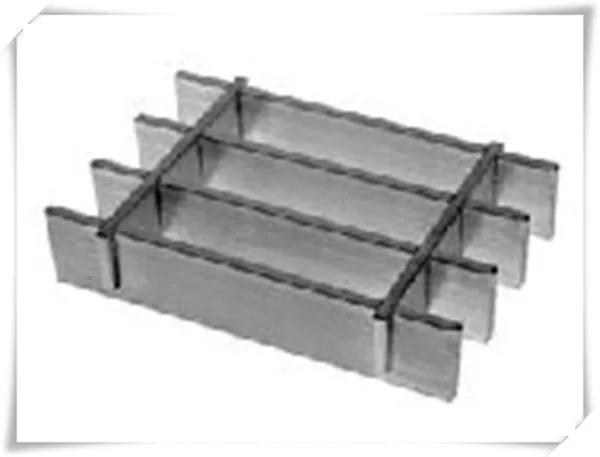
Press-locked steel grating, also called interlocked steel grating, is made from ordinary low-carbon flat bars, stainless steel, brass plates or aluminum plates of specified sizes through slotting (punching), interlocking, welding and finishing. The product has firm weld points, uniform hole spacing and an elegant, practical design. Press-locked steel grating has all the features of ordinary steel grating - high strength, corrosion resistance, maintenance-free - plus unique characteristics of uniform and precise combination, light and refined structure, natural harmony and elegant style. It is both a functional product and a work of art, and has been widely applied.
With the growth of comprehensive national strength, stricter environmental requirements and costly labor, plus the rapid development of demand at home and abroad, China's FRP grating manufacturing has been infused with vitality. For domestic manufacturers this is both an opportunity and a challenge. Building their own unique systems and a brand strategy is the necessary path for Chinese grating enterprises to enter the international market and succeed.
Once you grasp these basic concepts, the specifications and sizing recommendations that follow will be much easier to understand.
A practical tip for confirming specifications: write all four items - flat bar specs, bearing bar pitch, cross bar pitch, and overall dimensions - into the purchase list together; specifying only one or two often leads to mismatched deliveries. The complete specification marking of hot-dip galvanized steel grating is on the product page; number and check panel by panel against the layout drawing before ordering, and the same applies to galvanized steel grating.
Further notes: Common combinations of hot-dip galvanized steel grating and galvanized grating
Hot-dip galvanized steel grating and galvanized grating are different specification forms within the same product system. The selection logic is the same as described in this article: first the usage type, then span and load to determine specifications, and finally the environment to determine surface treatment. Their corrosion protection and anti-slip requirements may differ; state them separately when ordering rather than writing one general technical requirement.
- For all product specifications and theoretical weights by series, visit Steel Grating Product Center
- To estimate cost by size and quantity, use Instant Quote PageSubmit Requirements
- To see how similar projects were executed, refer to Project Cases field applications
FAQ
Where can I find specific specifications?
our websiteProductsCommon specifications and theoretical weights are organized by series, also available in Instant Quote PageEstimate by size, or contact us directly for sizing advice.
How to choose between hot-dip galvanizing and cold galvanizing?
The two anti-corrosion mechanisms differ: hot-dip galvanizing immerses steel in molten zinc to form a metallurgically bonded coating, thick and long-lasting, suitable for outdoor and humid environments; cold galvanizing is electrochemical deposition with a thinner, more uniform appearance, suitable for dry indoor environments or applications requiring high dimensional precision.
What is most often overlooked during installation and acceptance?
First, bearing bars installed in the wrong direction reduce load capacity; second, insufficient fixing points or missing zinc touch-up paint; third, support beam spacing inconsistent with the layout drawing. These three items are most often overlooked on site.
The above is for sizing and construction reference. To verify specific parameters or request a quotation, please visitInstant Quote Page, or contact our technical staff.
The above is general guidance. For a specific project, we still recommend submitting span, load class and service environment to our technicians for review. Steel grating is a load-bearing component; rework caused by wrong specification choices costs far more than the time spent on upfront calculation.