







On steel grating, this article covers what the standard says, why Q235B is sufficient, and when to use stainless steel in turn, giving actionable criteria rather than theory alone. Those with drawings or site dimensions can check against the key points; hot-dip galvanized trench covers can follow the same order.
What Does the Standard Say?
Article 7.1 of YB/T 4001.1-2019 states that bearing bars may use the following materials: carbon structural steel (per GB/T 700), high-strength low-alloy structural steel (per GB/T 1591), and also austenitic stainless steel and duplex stainless steel (per GB/T 4237, GB/T 3280).
But in actual production, Q235B carbon structural steel accounts for over 90% of usage. Why? In three words: sufficient, weldable, cheap.
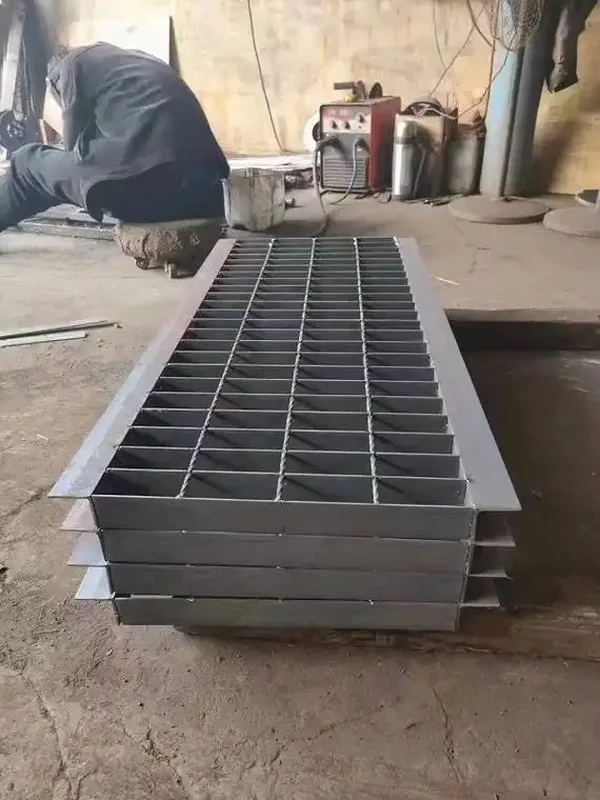
▲ Q235B carbon structural steel flat bars - the mainstay raw material of steel grating
When choosing material, do not simply chase the highest grade. The material of steel grating should match load requirements and service environment; over-specifying causes unnecessary cost. The corresponding treatment of steel grating trench covers can refer to the product page instructions, selected against actual working conditions.
Why Is Q235B Enough?
Q235B has a yield strength of 235MPa and tensile strength of 375-500MPa. For ordinary industrial platforms, walkways, and trench covers, this strength is more than enough. It also welds well and is not prone to cracking during pressure welding.
The 2019 edition made an important change from the 2007 edition: the old standard only mentioned "Q235-A or grade B steel", while the new standard extends it to "carbon structural steel and high-strength low-alloy structural steel", meaning high-strength steels such as Q345 and Q390 can now be used. This is good news for heavy-duty steel grating - the same section can use higher-strength material, reducing weight without reducing load.
Process choice directly determines the performance of finished steel grating. Welding and press-locking each suit different situations; neither is simply better - it depends on load requirements and service environment. The same logic applies to steel grating trench covers.
When to Use Stainless Steel?
Strongly corrosive environments such as food plants, pharmaceutical plants, and offshore platforms require stainless steel. The standard allows austenitic stainless steel (e.g. 304, 316L) and duplex stainless steel. Stainless steel grating costs 4-6 times as much as carbon steel but lasts far longer.
-- Lao Liang @ Anping Steel Grating Factory, July 2026
Choosing a surface treatment is essentially balancing initial investment against later maintenance. Requirements can be relaxed somewhat for steel grating in dry indoor environments, but should be raised for outdoor or humid environments. The same reasoning applies to selecting hot-dip galvanized trench covers.
Further notes: Common combinations of hot-dip galvanized trench covers and steel grating trench covers
In engineering, steel grating trench covers are often used together with the components mentioned in this article. The two differ in load carrying and installation practices; when combining them, pay special attention to the connection of support conditions and fixing methods, as junction treatment is often where problems arise. For unified drawings, submit dimensions of both types and our technicians will process them under the same layout logic.
- For all product specifications and theoretical weights by series, visit Steel Grating Product Center
- To estimate cost by size and quantity, use Instant Quote PageSubmit Requirements
- To see how similar projects were executed, refer to Project Cases field applications
If you already have drawings or site dimensions, submit them directly and we will help verify specifications and layout, avoiding on-site cutting and rework caused by mismatched models. Without drawings, site photos and approximate dimensions are enough for an estimate.