







Applications of grating rainwater gullies and steel grating in actual projects are not complicated; the difficulty lies in matching specifications, material, and service environment. This article covers the material and surface treatment of rainwater gullies, their main advantages, and the application scope and features of steel grating in turn; after reading, you will have a complete judgment framework for hot-dip galvanized steel grating.
Material and Surface Treatment of Rainwater Gullies
Common materials and surface treatments are as follows:
Steel GratingIt is a rainwater inlet grating material gradually coming into use in municipal facilities. Thanks to the high strength and easy processing of steel, products with corresponding load ratings can be produced for different road requirements while maximizing the water-flow cross-section; after hot-dip galvanizing, appearance and long-term use requirements are also met. Steel grating rainwater inlet gratings have been trialed for up to twenty years with essentially no damage requiring replacement.
Once material and surface treatment are decided, we recommend writing zinc coating thickness and appearance requirements into the technical agreement.
Regarding corrosion protection, one thing is easily overlooked: on-site cutting and welding damage the original coating, and these areas need zinc touch-up after construction, otherwise rust often starts from the cut edges. Hot-dip galvanized steel grating has the same issue; it is best to include this in the technical requirements at the construction disclosure.
Key Advantages
Its overall performance focuses on the following aspects; we suggest comparing item by item in actual selection:
In addition, a standout mechanical property of FRP (fiberglass) grating is its high specific strength (specific strength = strength divided by density or specific gravity). Its density is only 1/4 to 1/5 that of ordinary steel and about 1/3 lighter than aluminum. Therefore, an FRP grating of the same size weighs far less than a steel grating while meeting functional requirements. When on-site maintenance is needed, two workers can lift it, eliminating the need for gantry equipment.
Overall, selection should weigh span, load and service environment together.
In processing, the dimensional control of grating rainwater gullies and steel grating relies mainly on molds and tooling, so mass production is consistent, while special-shaped pieces need separate layout. When secondary on-site processing is needed, the anti-corrosion treatment of cut edges of galvanized steel grating must not be skipped either.
Application Scope and Features of Steel Grating
Main features can be summarized as follows:
- The dedicated sealing sleeves for on-site openings in steel grating installation suit reserved holes under 200mm in diameter, simplifying design and processing and improving production efficiency.
- With the dedicated sealing sleeves used at construction sites, one person with a single screwdriver can complete the entire installation process - simple and convenient.
- During on-site construction, clamps, bolts, and cover plates connect the otherwise independent load-bearing bars, dispersing the concentrated stress, strengthening the structure at the opening, and better ensuring safety in use. The sealing sleeves also cover the cut cross-sections at openings, improving the appearance of on-site openings, making the previously hidden openings easier to identify, eliminating safety hazards, and improving the visual effect of steel grating platforms.
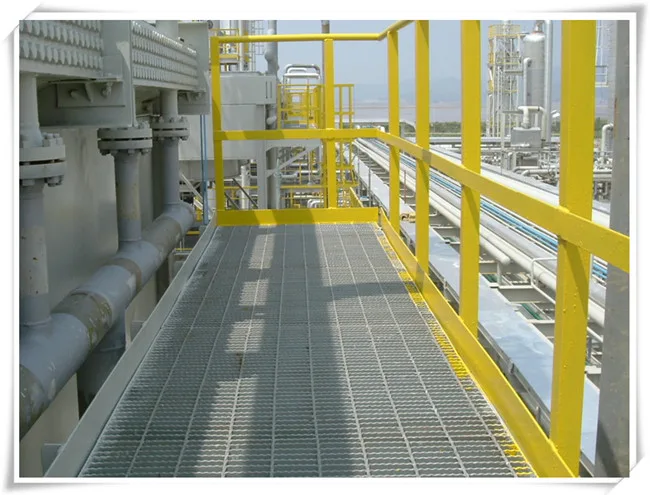
Dedicated platform steel grating for desulfurization towers is mainly used on large desulfurization tower platforms for easy operation and construction. As shown below: due to the special nature of desulfurization tower equipment, the grating used is special-shaped (fan-shaped) steel grating. Each hoisting structural unit of the desulfurization tower equipment platform is limited to 1 ton, and the platform decking should use checkered steel plate thicker than 4mm or anti-slip treated steel plate. The finished platform should be treated for corrosion protection.
Overall, selection should weigh span, load and service environment together.
Installation most affects the later user experience. When laying grating rainwater gullies and steel grating, the direction must not be reversed: the bearing bars should align with the main load direction - the point most easily overlooked on site. The number of fixings should also match the layout drawing; a missing one can cause local loosening. The same requirement applies to hot-dip galvanized steel grating.
Further reading: Sizing reference for hot-dip galvanized steel grating and galvanized grating
Besides what this article covers, hot-dip galvanized steel grating is also common in actual projects. It shares similarities with this article's subject in structure and fabrication; for selection, check span, load and service environment in the same order. If both types of components are used in the same project, we recommend unifying material and surface treatment to avoid later galvanic corrosion or inconsistent appearance.
- For all product specifications and theoretical weights by series, visit Steel Grating Product Center
- To estimate cost by size and quantity, use Instant Quote PageSubmit Requirements
- To see how similar projects were executed, refer to Project Cases field applications
FAQ
Can the values in the article be applied directly?
Values in this article come from relevant standard clauses or common industry practice. For actual selection, recalculate based on site span, load class and service environment; direct copying is not recommended.
What information is needed for custom sizes?
Usually you need to provide the panel dimensions (length x width), bearing bar specs and direction, center-to-center pitch of bearing bars and cross bars, surface treatment, and special requirements such as cutouts, corner notches and banding. Site photos or sketches are even better.
What is most often overlooked during installation and acceptance?
First, bearing bars installed in the wrong direction reduce load capacity; second, insufficient fixing points or missing zinc touch-up paint; third, support beam spacing inconsistent with the layout drawing. These three items are most often overlooked on site.
The above is for sizing and construction reference. To verify specific parameters or request a quotation, please visitInstant Quote Page, or contact our technical staff.
If you already have drawings or site dimensions, submit them directly and we will help verify specifications and layout, avoiding on-site cutting and rework caused by mismatched models. Without drawings, site photos and approximate dimensions are enough for an estimate.